 Angie Carrillo
Invest in your own company: why founders should become angels
Common stock is last in line in a sale. How founders, and their families, can invest on the same terms as investors, and the rules that keep it clean.
I'm not a lawyer or a financial advisor, and this is not financial advice. Talk to your lawyer and your accountant before you put your own money into your company.
01The question on every founder's mind
Can I invest in my own company, and should I?
02My position
Your share of your company shrinks every round. If every share you hold is common stock, you're last in line when the company sells.
It depends on your structure. In a single-member LLC the company is already yours, so investing in it changes little. In a Delaware C-Corp that is aiming to be a unicorn, your money can buy preferred shares.
Every founder puts money into the company at the start. There are always expenses: the first build, the lawyer, the trip to meet customers. Most founders never quantify that money, so it disappears into the company and buys them nothing extra.
My position is that it should go in as an angel investment in yourself, on paper, on the same terms as your investors, so it buys you preferred stock instead of vanishing.
Carta data shared by Peter Walker in July 2025 shows the median founding team ownership the day after each round closes. It covers 3,500+ US startups that raised in roughly the prior 18 months, no deep tech.
| Round | Median founding team ownership |
|---|---|
| Priced seed | 55.1% |
| Series A | 36.6% |
| Series B | 23.5% |
| Series C | 17.5% |
| Series D | 10.9% |
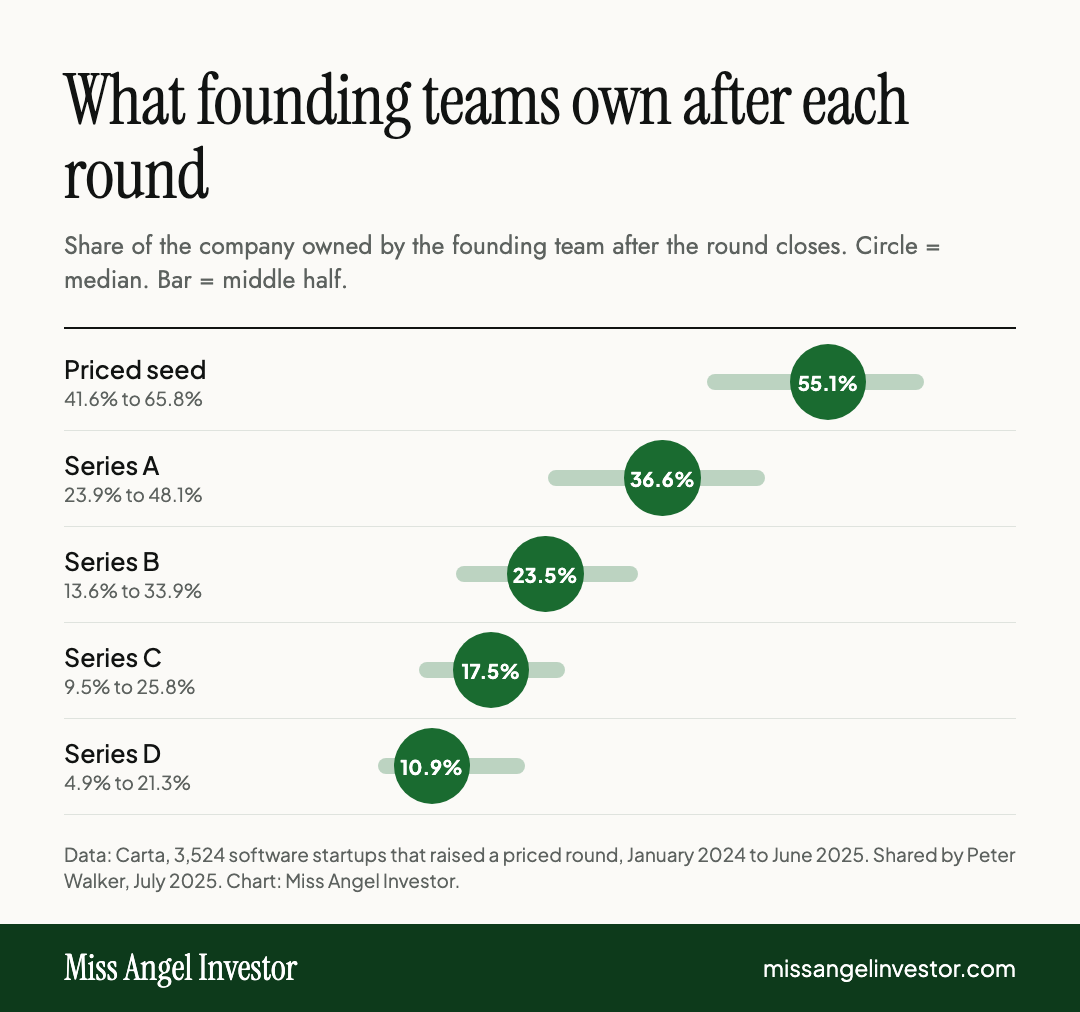
Only 1 in 5 founding teams own 50% or more after a Series A.
A newer Carta figure comes from a different sample. Shared by Peter Walker in March 2026, it covers 9,304 startups that raised from 2023 to 2025. After Series A, the median founding team owns 35.6%. These are medians across the cap table, and the employee option pool is a separate slice.
As an angel investor, my money goes into the same instrument every other investor in the round buys, and in a priced round that means preferred stock, paid back before common. Most founders I meet have never been told they can stand in that same line. I learned it from a unicorn founder who bought preferred stock in their own company for that reason: common is last in line.
Investing in your own company reads as commitment, until it's done in a way that looks like a side deal. Funds get uneasy when an insider vehicle holds a large slice with a preference bought on terms no outsider was offered, when ownership surfaces in diligence that nobody disclosed, or when a founder asks for liquidity before the company has proven much. And two shortcuts can sink a round: lending a relative money so they appear as the investor, and ticking the accredited box when they don't qualify.
As an investor, I take it as a very good sign when a founder tells me they put their own money in, at the same valuation as everyone else.
03How this works
Common and preferred
Founders and employees hold common stock. Investors hold preferred, which usually comes with a liquidation preference: in a sale, they get their money back before common sees a dollar. In a big exit everyone does well. In a modest one, the preference stack decides who gets paid.
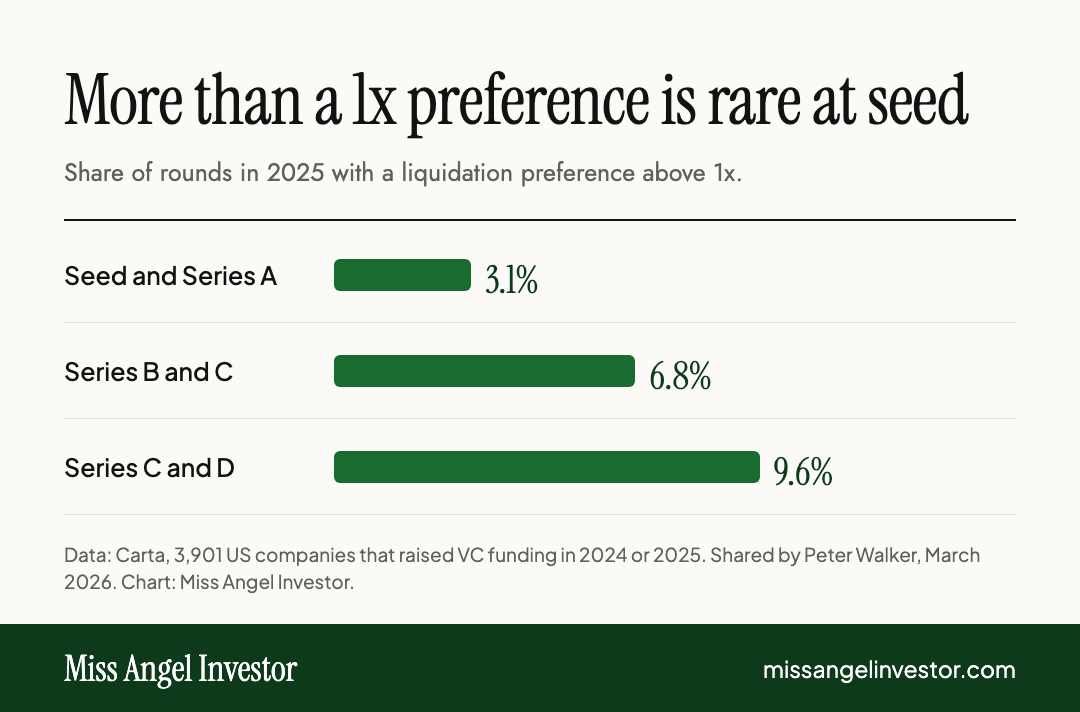
Carta data shared by Peter Walker in March 2026 shows that only 3% of seed and Series A deals in 2025 had a liquidation preference above 1x. A 1x preference means the investor gets their invested capital back first when the company exits. Investors usually choose between that preference and their ownership percentage, whichever is higher.
A 2025 NBER study of US venture-backed companies by Azevedo, Scheuer, Smetters and Yang found that founders were collectively wiped out in 74% of cases, either because the company failed or because investors took all the proceeds of a weak exit. Even among companies that reached an IPO or acquisition, 24% left founders with nothing, because investor protections kicked in after down rounds.
How a founder invests
- You already qualify. A director or executive officer counts as an accredited investor for their own company's round, whatever their income or net worth. To angel invest in other companies, you need to qualify personally, through the income, net worth or license tests below.
- Quantify what you've already put in. If you've been paying company expenses yourself, ask your lawyer about documenting that money as a SAFE or note, instead of leaving it as an untracked contribution.
- Same instrument, same price, same time. Buy the same SAFE or preferred stock as your outside investors, in the same round. If insiders get a better price, the discount can be taxed as compensation.
- Approve and disclose. It's a related-party transaction: your board approves it, and your investors know it's you.
How family can invest
- Accredited family members can invest like any angel. They qualify with over $200K in income in each of the last two years, or $300K with a spouse, with over $1M in net worth excluding their home, or with a Series 7, 65 or 82 license.
- Family living outside the US can usually invest under Regulation S, which has no accreditation test. Residence decides it, whatever their passport: a mother in Bogotá qualifies, a sister in Miami doesn't. Their home country's securities and tax rules apply, and holding US stock directly can bring US estate tax, so they need their own advice.
- Non-accredited family in the US can join under Rule 506(b), which allows up to 35 financially sophisticated non-accredited investors. One of them triggers a formal disclosure package, which is why lawyers resist it, but it's a real option for one or two relatives.
Taking money off the table
The same study found that 84% of founders ended with zero exit value, and among those who got something, the median payout was $5.6M while the average was $45.6M, pulled up by a few huge outcomes. Later, in a priced round, you can sell a small part of your stake to the new investor in a secondary sale. It needs board consent and a buyer who wants it, and most Series A funds keep secondaries small, because they want their money in the company.
What changed
The SEC has proposed letting individuals become accredited by passing an exam. It isn't available yet: the test still has to be built and approved. Until then, the Series 65 is the exam route open to people outside the industry.
The framework: rules that keep it clean
- Invest on identical terms, at the same time as outside investors.
- Keep insiders a minority of the round.
- Disclose it and get board approval.
- Only put in money you can afford to lose.
- Sell small, and only once the company has proven something.
Note
This guide is educational, not legal, tax or financial advice. Use it to ask a startup lawyer better questions before you or your family invest.
The math, with made-up numbers
These numbers are invented and simplified. Real waterfalls depend on your documents.
Say you own 30% of the company as common. You also put $40K of your own money into a $1M seed round on investor terms. Investors have put in $5M in total, which includes your $40K, with a 1x non-participating preference, and they own 40%. The company sells for $6M.
- Investors compare $5M with 40% of $6M, which is $2.4M. They take the $5M preference.
- That leaves $1M for the other 60% of the company.
- Your 30% is half of that 60%, so your common pays you $500K.
- Your $40K sits inside the preferred, so it comes back first as part of the $5M.
You walk away with $540K.
If you had paid $40K of company expenses yourself instead, untracked, on top of the same $5M round, your common would still pay $500K and the $40K would be gone.
The preference beats ownership until 40% of the sale price reaches $5M, which happens at $12.5M. Above that, investors take their percentage instead.
In practice
Tope Awotona started Calendly with his own savings and a small-business loan, and raised only about $550K in its early years. In January 2021 it raised $350M at a valuation of about $3B, and more of that round went to buying shares from early shareholders and employees than into the company.
04Try it with AI
Copy this prompt into Claude or ChatGPT, fill in the brackets and run it on your own company.
I'm a founder raising a [round type] of [$amount] on [SAFE / priced round] terms. I'm based in [country] and my company is a [entity type]. I'd like to invest [$] myself, and these family members want to invest: [where each lives, rough income or net worth]. Explain which route each of us could use, the documents and approvals involved, what investors might worry about, and the 10 questions to bring to a startup lawyer.
Data: Carta data shared by Peter Walker, July 2025, March 2026 on founder ownership and March 2026 on liquidation preferences. NBER study by Azevedo, Scheuer, Smetters and Yang: nber.org/papers/w34512.
Educational content, not legal, tax or financial advice.
Want help applying this to your company? Yearly 1:1 coaching, by application.
Work with me →Make money first: ship the product, then choose your raise
Among 54,601 US startups on Carta that haven't raised from VCs, the solo-founded share doubled from 18% in 2016 to 36% in 2025.
Raise moneyMost startup fundraises fail before they start
The 8 T's investors evaluate: team, traction, trust, tempo, TAM, technology, terms and timing.