 Angie Carrillo
Negotiation and closing: the term sheet terms that matter
Valuation is one line on the term sheet. These are the other terms that decide what you take home, and how to close.
01The question on every founder's mind
Beyond the valuation, what in a term sheet should I fight for?
02My position
The headline valuation gets the attention, and the rest of the term sheet decides what you keep.
I've seen a liquidation preference stack change what a founder takes home far more than the valuation did. The terms you accept in this round become the starting point for the next one, so read every line with your lawyer before you sign.
I have not seen that many term sheets. As a founder, my lawyers at Cooley reviewed them for me, and I'd tell you the same: have your lawyer review a term sheet before you sign. Today my own first pass would be ChatGPT or Claude, before the lawyer.
A higher valuation with heavy terms can leave you with less than a lower valuation with clean ones.
A 2025 NBER study found that 24% of venture-backed companies that reached an IPO or acquisition still left their founders with nothing, because liquidation preferences and anti-dilution provisions kicked in after down rounds.
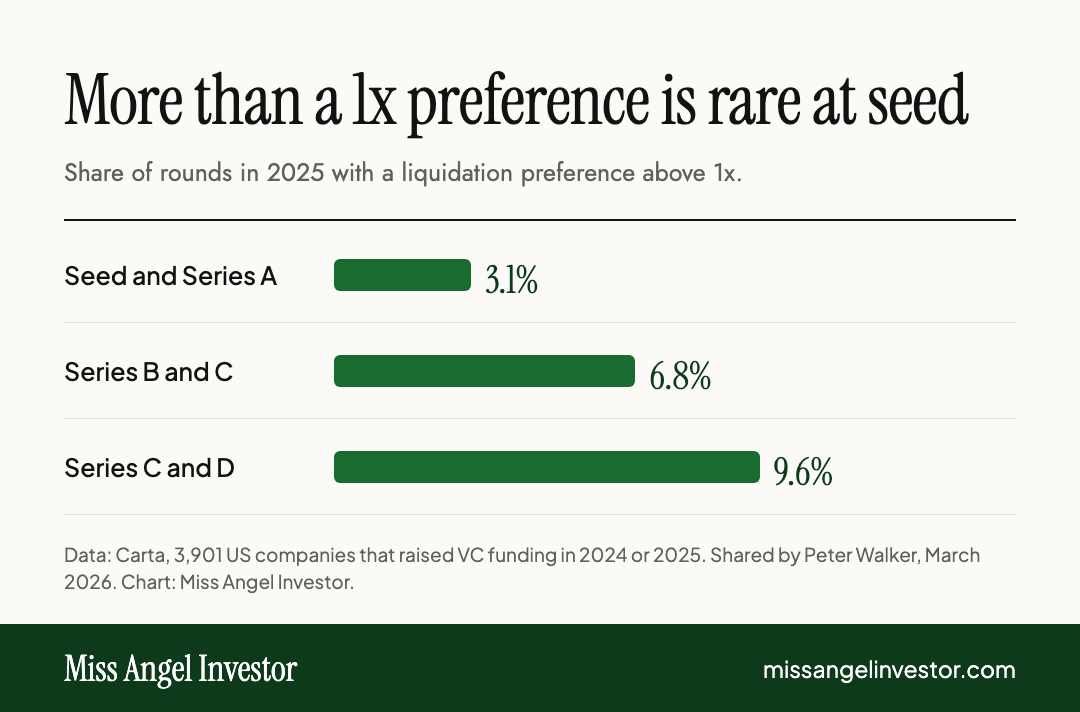
Early rounds almost never carry more than a 1x preference. Carta data shared by Peter Walker covers 3,901 US companies on Carta that raised VC funding in 2024 or 2025. In that data, 3.1% of Seed and Series A rounds in 2025 had a liquidation preference above 1x. A 2x on your term sheet stands out, so ask your lawyer about it first.
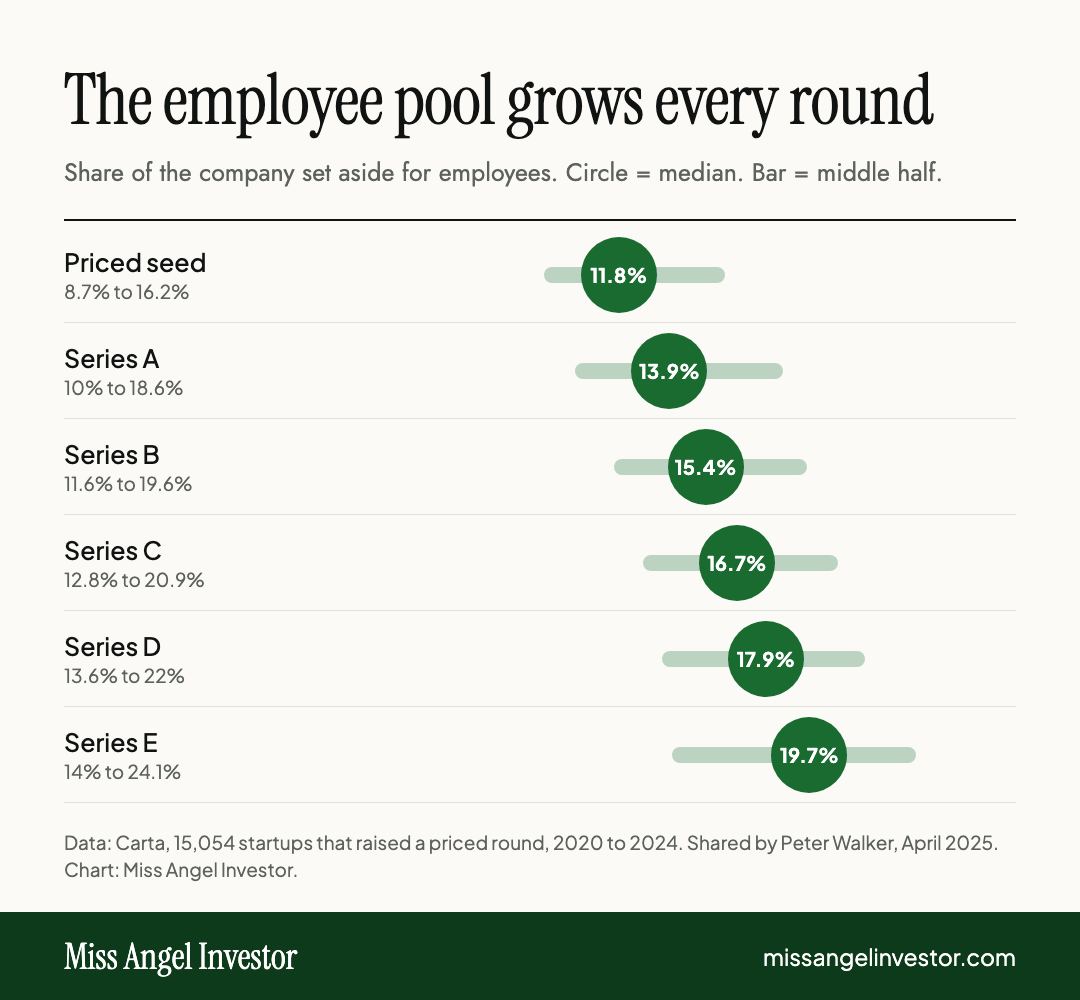
The option pool is the quieter term. Carta data shared by Peter Walker puts the median pool after a seed round at 11.8%. Peter adds that most companies use 60% to 70% of it before their next raise.
03How this works
- Valuation and the option pool. If the investor asks for a bigger option pool created before the money comes in, the dilution comes out of your share. Size the pool to your real hiring plan.
- Liquidation preference. Who gets paid first in a sale. One times the investment, non-participating, is the founder-friendly standard.
- Board seats. Who controls the board after the round. Early on, founders usually keep a majority.
- Pro rata rights. The investor's right to keep their percentage in future rounds. Common and reasonable for leads.
- Protective provisions. Decisions that need the investor's approval. Keep the list short and standard.
- Anti-dilution. Protection if a future round is priced lower. Broad-based weighted average is standard. Full ratchet is a red flag.
What the data says about two of these terms
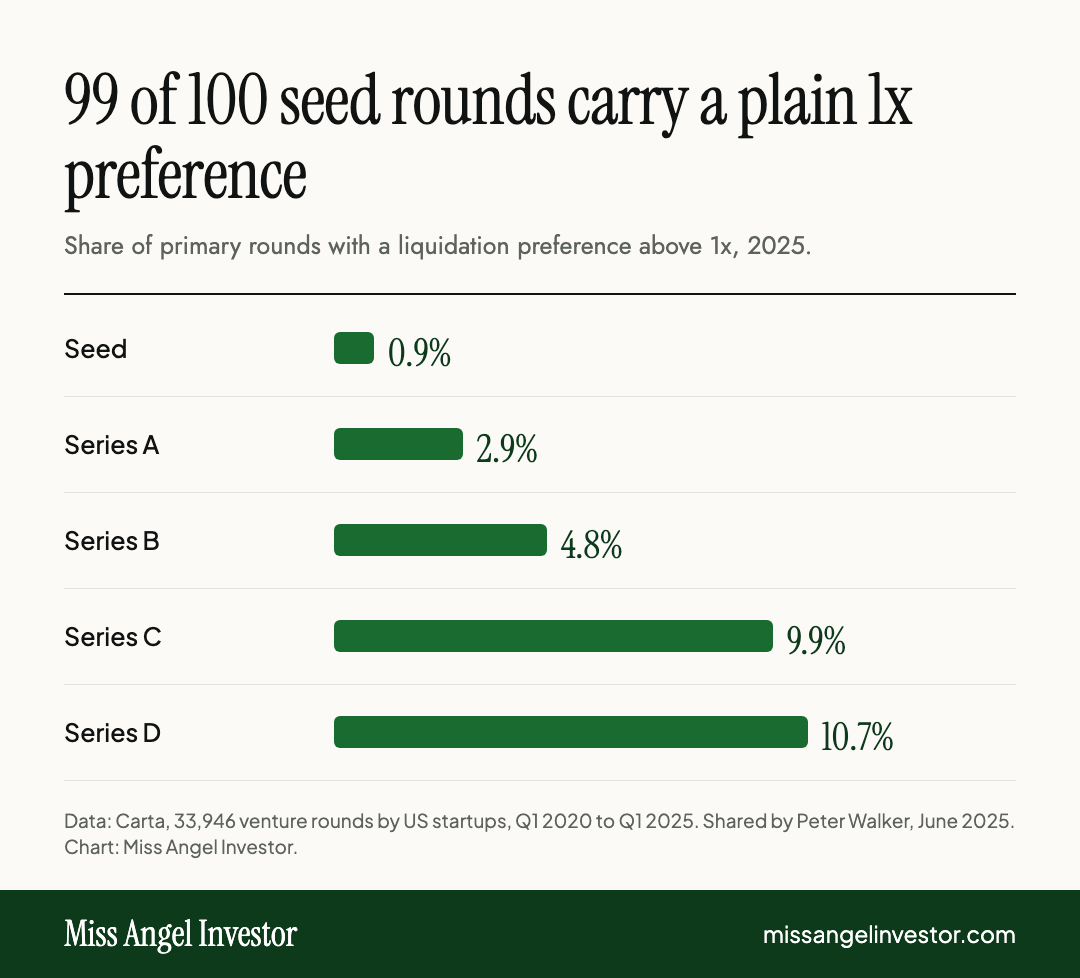
Share of completed deals with a liquidation multiple over 1x, in 2025. The data is 33,946 venture rounds raised by US startups on Carta, Q1 2020 to Q1 2025, so 2025 is the first quarter only.
| Stage | Primary round | Bridge round |
|---|---|---|
| Seed | 0.9% | 3.1% |
| Series A | 2.9% | 5.7% |
| Series B | 4.8% | 10.6% |
| Series C | 9.9% | 8.1% |
| Series D | 10.7% | 23.5% |
Employee option pool after the round. The data is 15,054 startups that raised a priced venture round from 2020 to 2024.
| Stage | 25th percentile | Median | 75th percentile |
|---|---|---|---|
| Priced Seed | 8.7% | 11.8% | 16.2% |
| Series A | 10.0% | 13.9% | 18.6% |
| Series B | 11.6% | 15.4% | 19.6% |
| Series C | 12.8% | 16.7% | 20.9% |
What a round looks like by stage
SaaS five-year medians from the Carta round benchmarking tool, priced rounds Q3 2021 to Q3 2026, all of the USA. Each column is its own median, so a row will not add up.
| Stage | Deal size | Pre-money | Post-money | Dilution |
|---|---|---|---|---|
| Seed | $3.9M | $15.0M | $19.6M | 20.1% |
| Series A | $12.4M | $50.0M | $62.8M | 20.0% |
| Series B | $29.1M | $145.0M | $175.0M | 15.5% |
| Series C | $50.0M | $335.7M | $397.6M | 11.1% |
| Series D+ | $100.0M | $1,062.5M | $1,196.0M | 7.9% |
The math, with made-up numbers
You have two offers for the same $2M. Every number here is made up.
Offer 1 values you at $10M pre-money, so $12M post-money. The investor owns 16.7%. The terms are a 2x participating preference and an option pool of 15% after the round, created before the money comes in.
Offer 2 values you at $8M pre-money, so $10M post-money. The investor owns 20%. The terms are a 1x non-participating preference and an option pool of 10% after the round.
Participating means the investor takes the preference first and then shares in what is left. Non-participating means the investor takes the larger of the preference or their ownership share.
You and your cofounders own everything outside the investor's shares and the pool. There is no debt, no fees, and the whole pool is granted. The company sells for $20M.
Ownership at closing is 68.3% in Offer 1 and 70% in Offer 2. The higher valuation already leaves you with less.
Offer 1 at a $20M sale:
- The investor takes the 2x first, $4M.
- $16M is left. The investor owns 16.7% of it, $2.67M.
- You own 68.3% of the $16M, which is $10.93M.
Offer 2 at a $20M sale:
- The 1x preference is $2M. 20% of $20M is $4M. The investor takes the larger, $4M.
- You own 70% of the $20M, which is $14M.
The offer with the higher valuation pays you $10.93M. The offer with the lower valuation pays you $14M. That is a gap of $3.07M.
Now go one step further. Change only the preference in Offer 1 to 1x non-participating. The investor's 16.7% of $20M is $3.33M, more than the $2M preference, so the investor takes $3.33M. You own 68.3% of the $20M, which is $13.67M.
The preference accounts for about $2.7M of the gap. The other $0.3M or so comes from the pool, where 5 extra points of pool cost you more than the 3.3 points the higher valuation saves.
From signature to money in the bank
After the term sheet comes confirmatory due diligence, the final legal documents, signatures and the wire. A ready data room can cut weeks from this stage.
The framework
- Competition sets your price. Several interested investors on the same timeline is the strongest leverage you'll ever have.
- Anchor with data. Bring comparable rounds and your metrics.
- Don't negotiate against yourself. Make your proposal, then wait for theirs.
- Keep it private. Never share who else gave you terms.
- Keep building while lawyers work. Tell your team once the money has landed.
This guide is educational, not legal or financial advice. Bring this list to your lawyer and ask them to flag any term outside market standard.
04Try it with AI
Copy this prompt into Claude or ChatGPT, fill in the brackets and run it on your own company.
Here is the term sheet I received: [paste the key terms]. Explain each term in plain language, flag anything outside market standard for a [stage] round, and model what I'd take home in a sale at [$X], [$Y] and [$Z]. Then suggest the two terms I should push back on first and how to phrase the ask.
Data: Carta data shared by Peter Walker, posts of 2026-03-11, 2025-04-21 and 2025-06-26. Round medians: Carta round benchmarking. Study: NBER.
Educational content, not legal, tax or financial advice.
Want help applying this to your company? Yearly 1:1 coaching, by application.
Work with me →Read the no: what an investor's rejection is telling you
I took every single no personally. Then I saw how it works on the other side.
Raise moneyLooksmaxxing for founders
What being a beauty queen taught me about the first seconds of a pitch, and the small tweaks that help when you don't look like the typical founder.