 Angie Carrillo
The data room checklist: be ready before due diligence
A clean data room speeds up your close and signals that you run a tight company. Build it before the first meeting.
01The question on every founder's mind
What will investors ask to see, and when do I need it ready?
02My position
Have your data room ready before an investor asks for it.
My own diligence is better now than it was. I used to invest through syndicates and assume they had done the diligence. I learned it is much better to do your own.
A data room is the first look an investor gets at how you run the company. A clean one shows you are organized and have nothing to hide. A messy one starts a quiet list of doubts that follows you into the negotiation. Every day between term sheet and closing is a day something can go wrong, like a bad month, a market shift or a partner who changes their mind. A ready data room is the cheapest insurance you can buy against a deal falling apart.
Start with the cap table. The mistake I see most is founders who don't manage their math. They sign one SAFE after another and end up diluted by more than 20% before their priced round. Most of them find out how much they sold when their accountant or finance person does the finances.
When I read a cap table, I look for red flags and I look at who is on it. Angel investing is a community, a very expensive network. I want to know whether I know the people on the cap table and whether I could call one of them to ask how things are going.
So you know what a normal cap table looks like, here are the medians from Carta data shared by Peter Walker. The dataset is 14,911 startups that raised a priced venture round from 2020 to 2024. Each number is a median. Your own cap table will differ. The chart does not include advisors or board members.
| After the round | Founding team | Employee pool | Investors in the round | Prior investors |
|---|---|---|---|---|
| Priced seed | 56.2% | 11.8% | 21.0% | 11.0% |
| Series A | 36.1% | 13.9% | 21.6% | 28.4% |
| Series B | 23.0% | 15.4% | 18.0% | 43.6% |
| Series C | 15.7% | 16.7% | 14.2% | 53.4% |
| Series D | 11.4% | 17.9% | 11.1% | 59.6% |
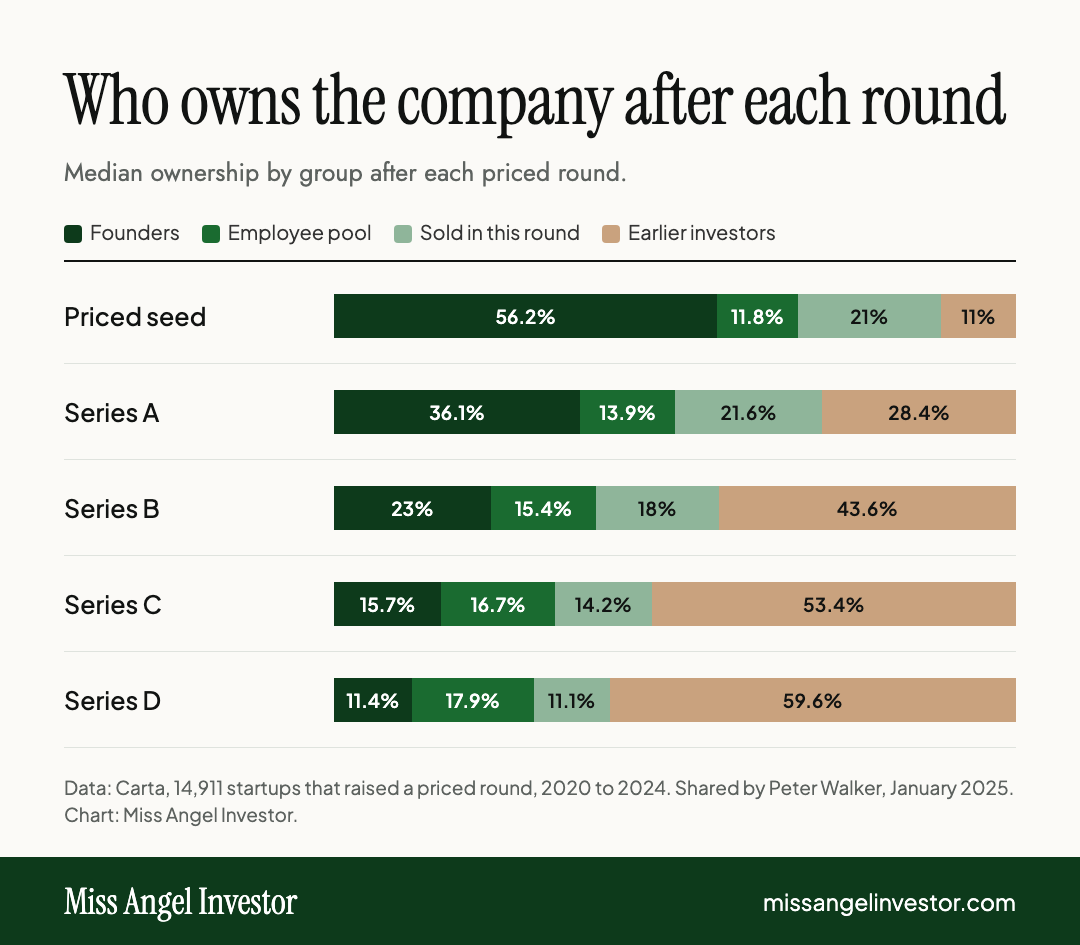
Your SAFE investors are in the prior investors column at the priced seed. By Series B, the founding team's median is 23.0%. At Series C, the employee pool at 16.7% is larger than the founding team at 15.7%.
The option pool is the line to check against your own. The same Carta data covers 15,054 startups that raised a priced venture round from 2020 to 2024. The 25th and 75th percentiles show the range around each median.
| Stage | 25th percentile | Median | 75th percentile |
|---|---|---|---|
| Priced seed | 8.7% | 11.8% | 16.2% |
| Series A | 10.0% | 13.9% | 18.6% |
| Series B | 11.6% | 15.4% | 19.6% |
| Series C | 12.8% | 16.7% | 20.9% |
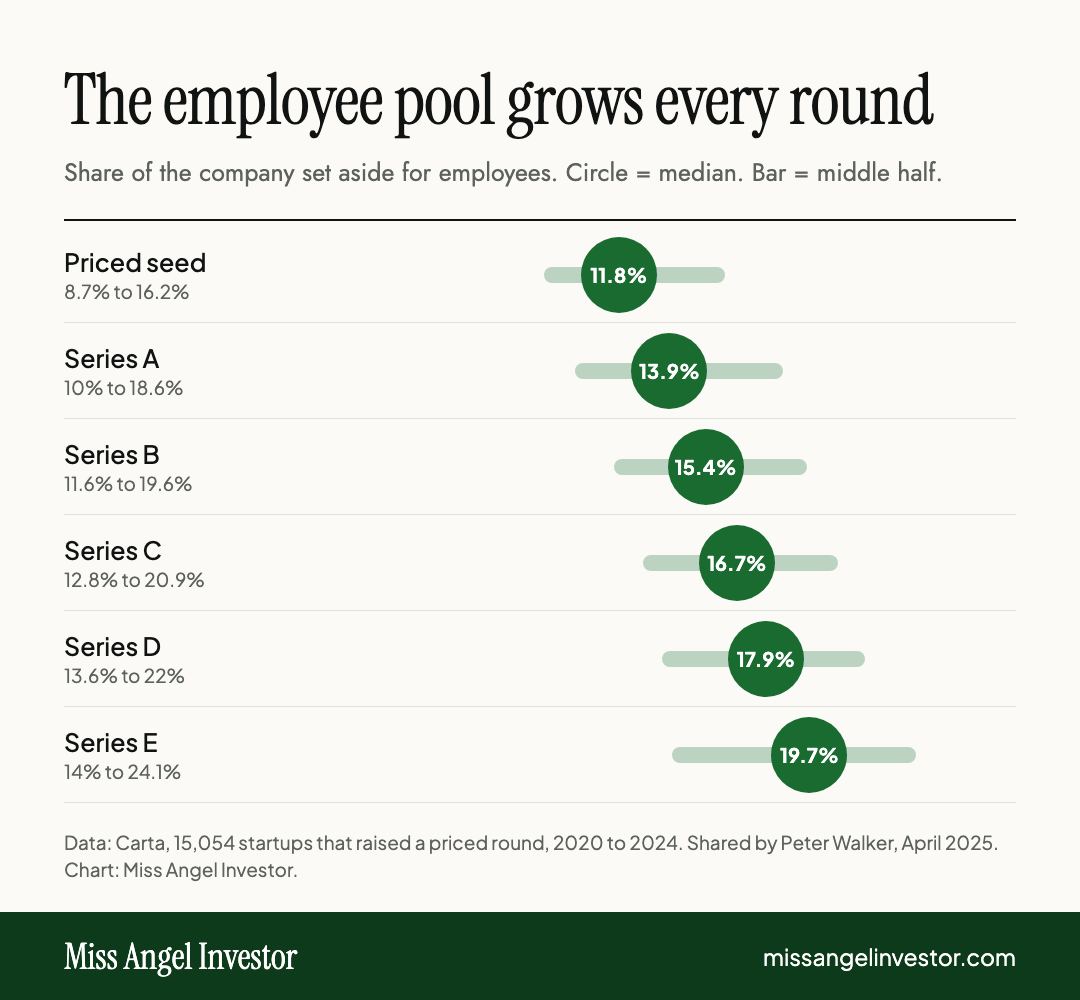
If your pool sits outside the middle range, or your founder share sits far from the median, have the reason ready before an investor asks.
03How this works
Due diligence is how an investor checks that what you said in the pitch is true. The data room is where they do it.
Data room light: what to send first
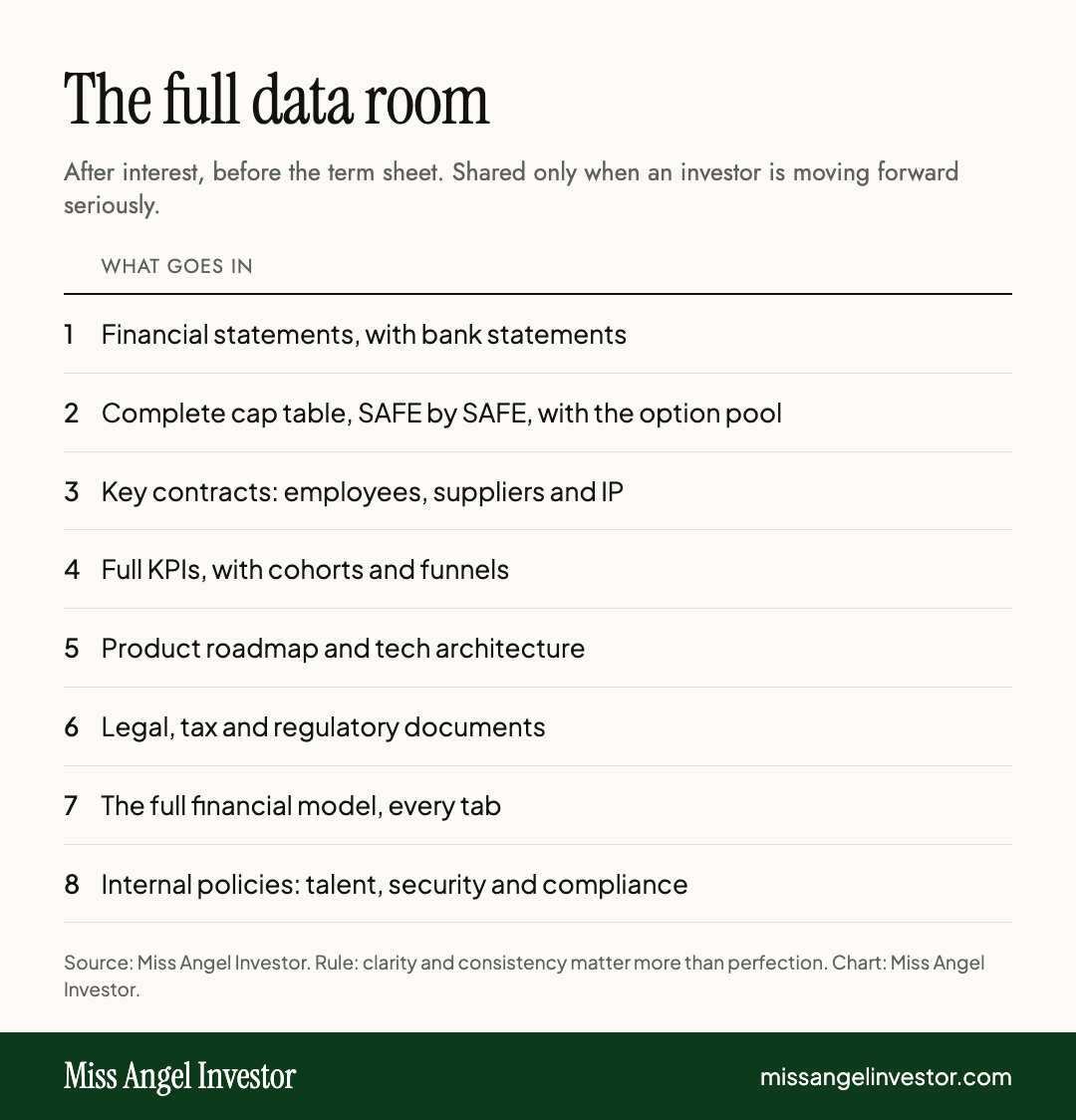
You don't open the whole room on first contact. I use a light version to start conversations. It shows you are organized without revealing everything.
- Pitch deck
- A teaser of your financial model
- Basic cap table, with your SAFEs
- Incorporation documents
- A short founder video, 2 to 3 minutes
- A one-pager of your key numbers
- A product demo
- A press kit, if you have one
The goal is to open conversations and find the investors who are interested enough to ask for the full room. The full room comes next.
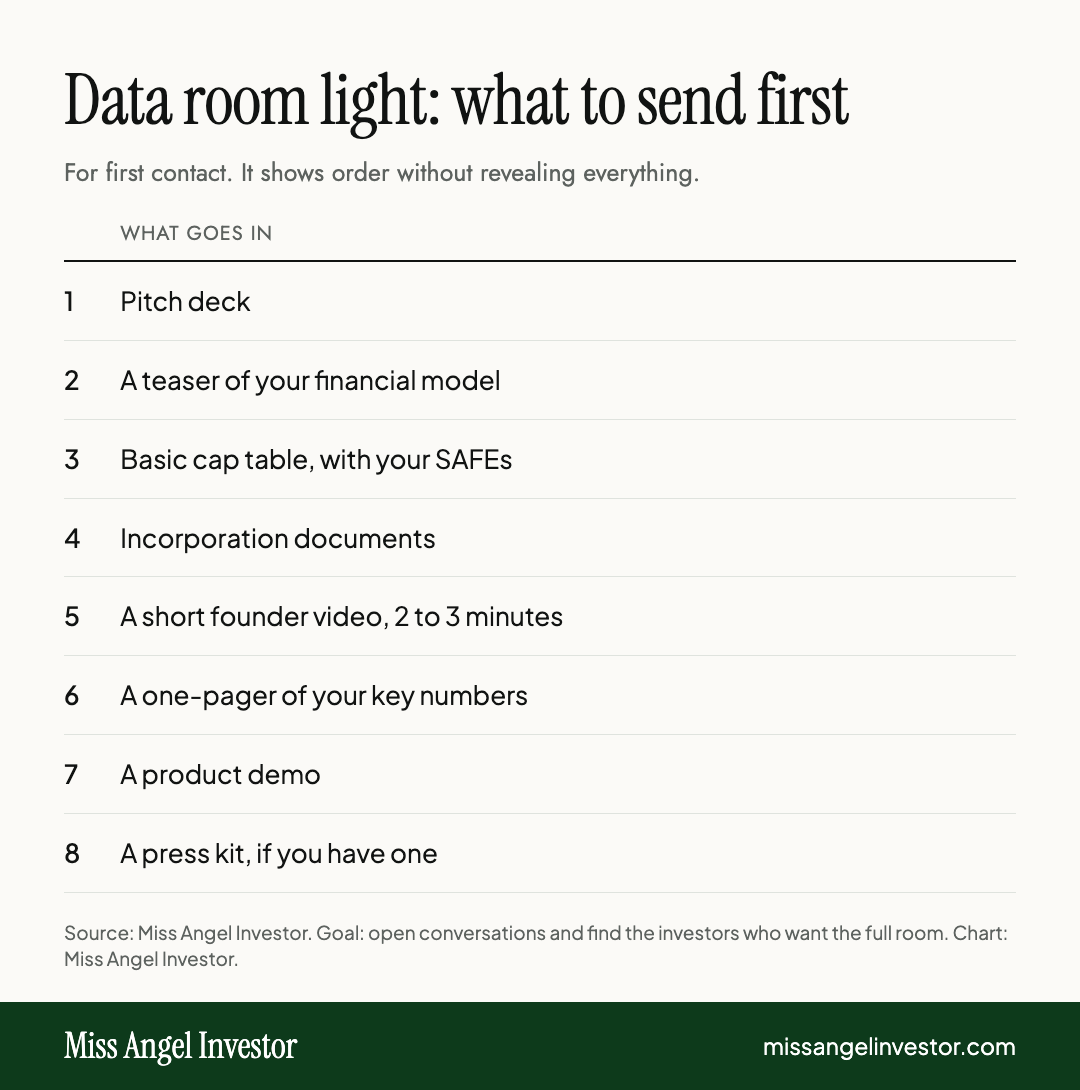
The full data room: after interest, before the term sheet
You share this one only when an investor is moving forward seriously.
- Financial statements, with bank statements
- Complete cap table, SAFE by SAFE, with the employee option pool
- Key contracts: employees, suppliers and IP
- Full KPIs, with cohorts and funnels
- Product roadmap and tech architecture
- Legal, tax and regulatory documents
- The full financial model, every tab
- Internal policies: talent, security and compliance
My rule for this room: clarity and consistency matter more than perfection.
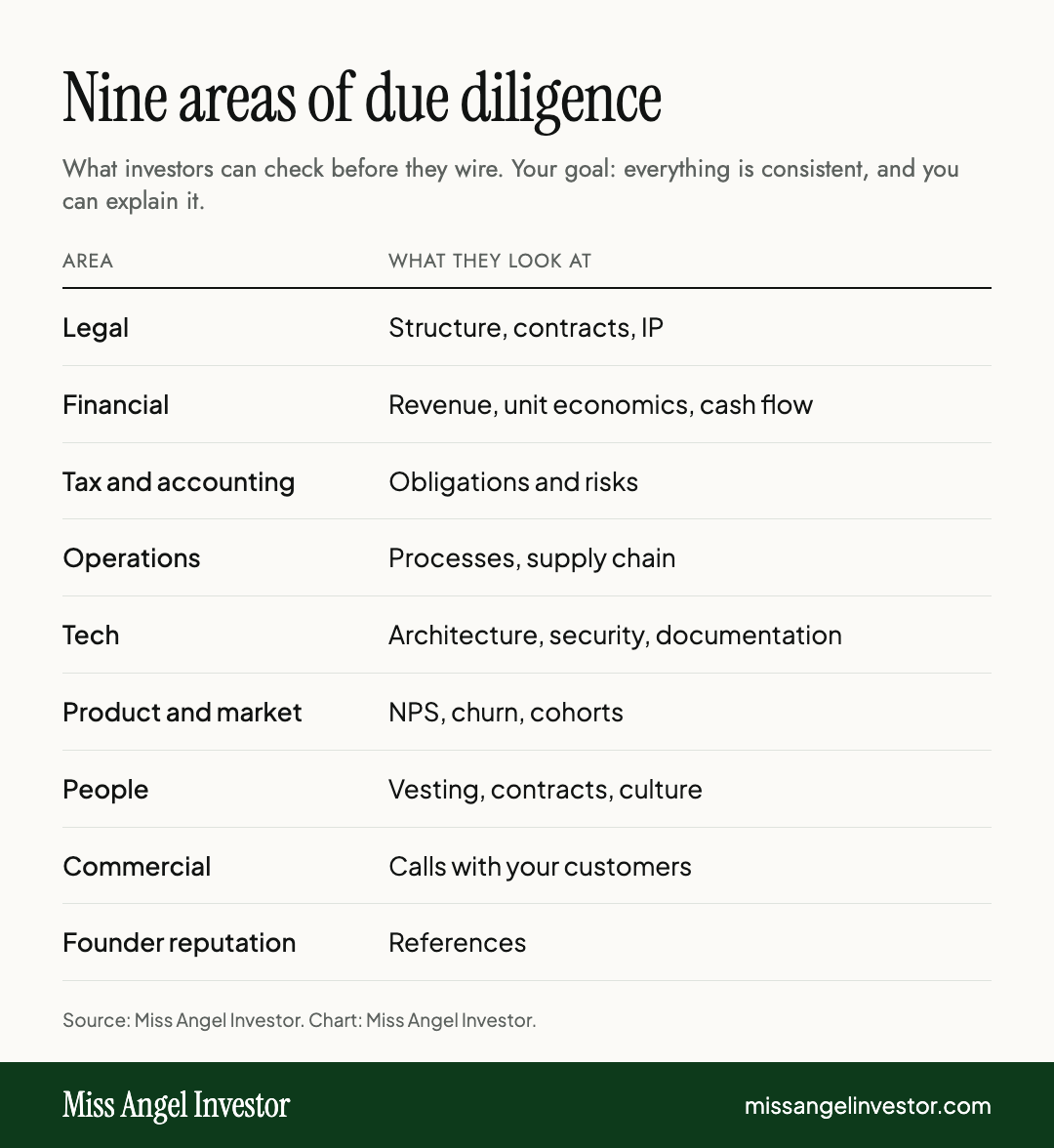
The nine areas investors can check
Due diligence can go in nine directions. Know which ones your investor will open.
| Area | What they look at |
|---|---|
| Legal | Structure, contracts, IP |
| Financial | Revenue, unit economics, cash flow |
| Tax and accounting | Obligations and risks |
| Operations | Processes, supply chain |
| Tech | Architecture, security, documentation |
| Product and market | NPS, churn, cohorts |
| People | Vesting, contracts, culture |
| Commercial | Calls with your customers |
| Founder reputation | References |
Your goal across all nine: everything is consistent, and you can explain it.
The framework
Build it once, keep it updated monthly and share it the day an investor asks. Create the folders today, even if half are empty. The gaps show you what to fix before you raise. Start with the cap table, because it has to match every SAFE and option document you hold.
The math, with made-up numbers
Say you raised three SAFEs, and the cap went up each time because you had more to show.
- $150K on a $3M post-money cap is 5%.
- $300K on a $6M cap is 5%.
- $500K on a $10M cap is 5%.
Your SAFE investors own 15% and you own 85%.
Now say the cap table in your data room lists only the first two SAFEs. It shows 10% for your SAFE investors and 90% for you.
Next comes a seed round of $2M at a $10M pre-money valuation. The new investors own 16.7%, and everyone who owned shares before is cut by the same fraction.
- The true cap table: SAFE investors 12.5%, you 70.8%.
- The incomplete one: SAFE investors 8.3%, you 75.0%.
The missing SAFE is a 4.2 point gap in your share. Fix it before anyone else finds it. Carta's median founding team owns 56.2% after a priced seed, so check your own number against that before you sign.
Ask your lawyer to review the legal documents and the cap table before you share the full room.
04Try it with AI
Copy this prompt into Claude or ChatGPT, fill in the brackets and run it on your own company.
Here is a list of the documents I currently have: [paste]. Compare it to a standard seed-stage data room. Tell me what's missing, which gaps an investor would see as a red flag, and the order I should fix them in over the next 30 days.
Data: Carta data shared by Peter Walker, posts of 2025-01-22 and 2025-04-21, priced venture rounds from 2020 to 2024.
Educational content, not legal, tax or financial advice.
Want help applying this to your company? Yearly 1:1 coaching, by application.
Work with me →