 Angie Carrillo
The pitch deck investors read
Ten slides, one story. The order that works, and what each slide has to prove.
01The question on every founder's mind
What makes an investor keep reading my deck?
02My position
Lead with your strongest proof. Whether that is traction or your team, it goes up front.
The deck mistake I see most is using one deck for everything. You need one for presenting, where you do the storytelling out loud. You need a second version, a one-pager or a longer deck with more words, that tells the story when you are not in the room.
I've read a lot of decks, as an investor and on the selection side. The ones that work tell one story and answer the investor's questions before they ask. The ones that don't make the investor do the work.
Martin Tobias, a pre-seed investor, posted in June that last year he looked at 4,500 decks and wrote 11 checks. Peter Walker, who led insights at Carta, shared it in a post on LinkedIn. That is about 2 checks per 1,000 decks. Walker's view is that the number runs high but fits pre-seed and seed. It is one investor's year, so read it as a sense of scale.
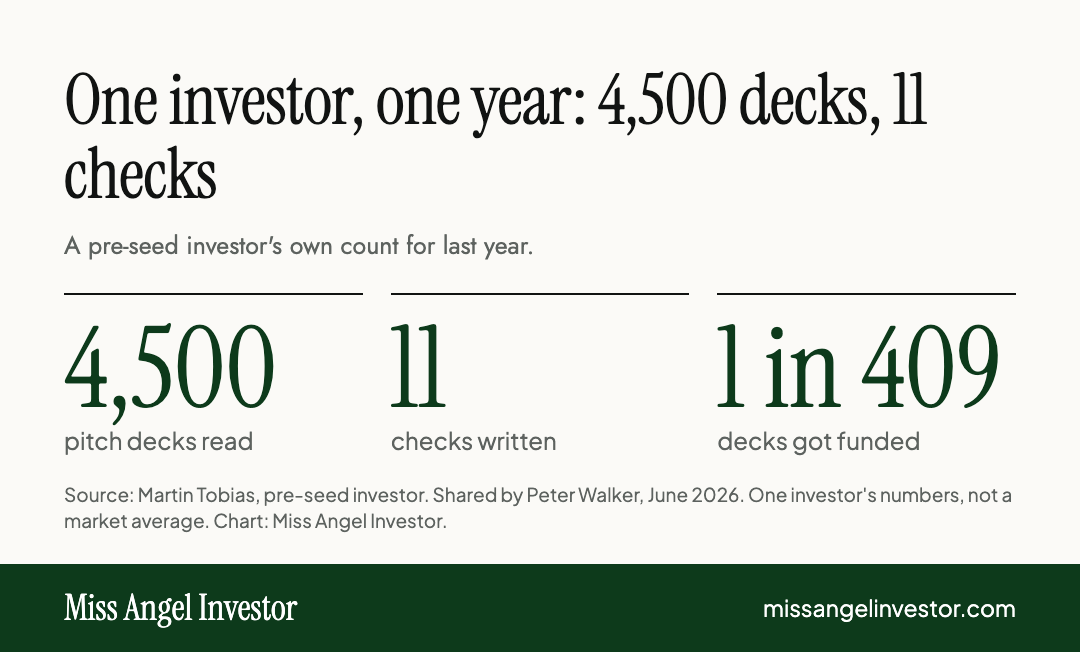
An investor with a stack that size needs one reason to keep going on each deck. Put your best proof where that reader meets it first.
AI on your cover will not be that reason. Carta data shared by Peter Walker, on US software startups on Carta, shows the share of capital raised that went to AI companies. It was 23% in 2018 and 50% in 2025. Without the largest late-stage rounds, 2025 is 48%. Carta data shared by Peter Walker is in this LinkedIn post.
| Year | Share of capital raised that went to AI |
|---|---|
| 2018 | 23% |
| 2019 | 25% |
| 2020 | 27% |
| 2021 | 34% |
| 2022 | 32% |
| 2023 | 40% |
| 2024 | 49% |
| 2025 | 50% |
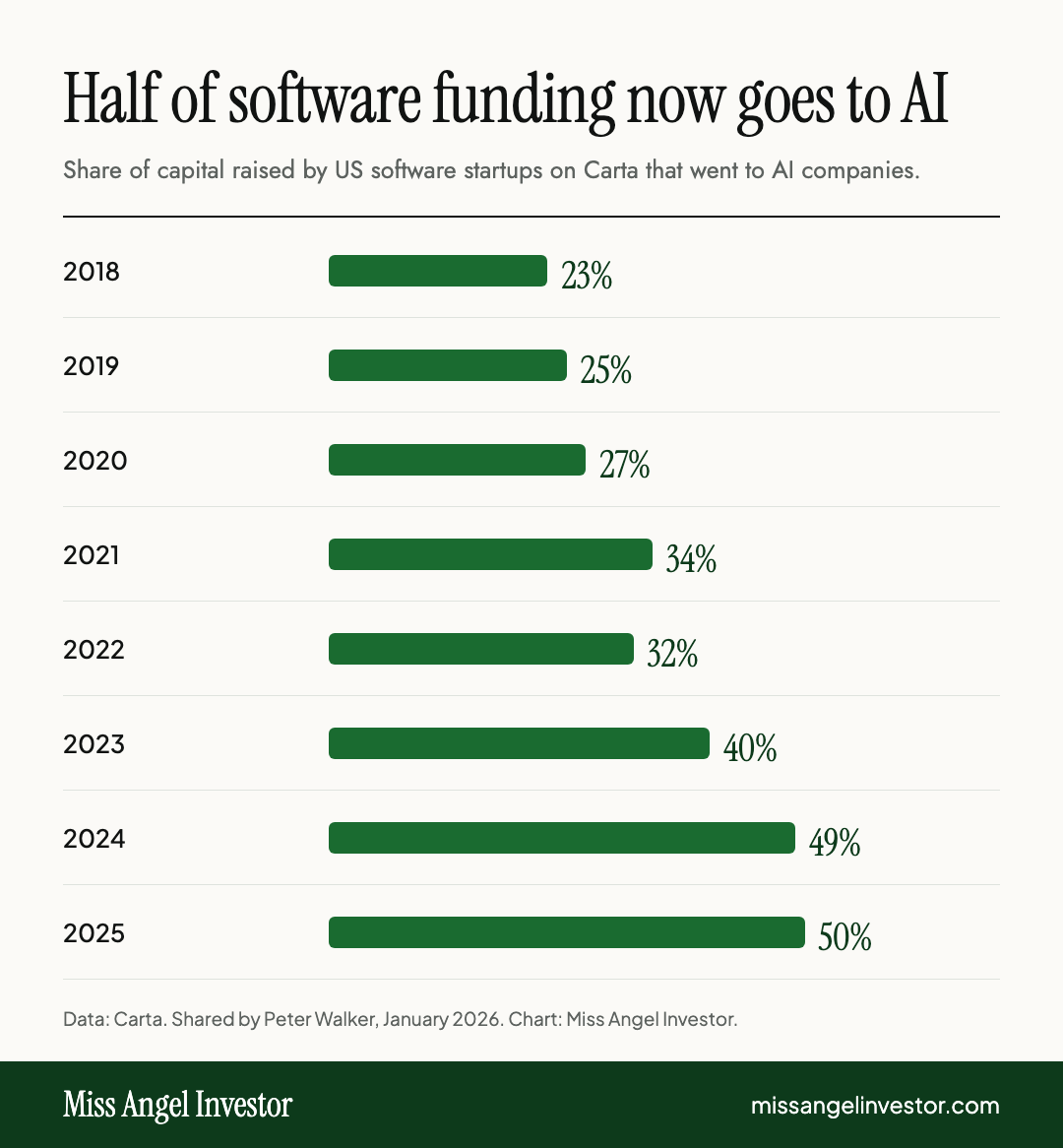
When half the capital goes to AI companies, the word AI on your cover puts you in the group that took half the money. Lulu Cheng Meservey said on TBPN that the buzzwords have run out of value and that people are fatigued. Her advice is to say what the product does and then prove it. That is the opening for your deck.
03How this works
Ten slides carry the story. Each one answers the question the investor has next.
- The one-liner. What you do, for whom. See your one-liner.
- Problem. Who has it, how painful it is, how they solve it today.
- Solution. What you built and why it beats the workaround.
- Traction. Your best number, early.
- Market. Bottom-up: customers times what they would pay.
- Business model. How you make money, and your unit economics.
- Competition. Who else is solving this and why you win.
- Team. Why you are the people who get this done.
- Go-to-market. How you reach your next customers.
- The ask. How much, and the milestone it buys. See how much to raise.
The asks I trust are tied to milestones. I need this money to get to this milestone, then this amount to get to the next one.
The framework
Build the deck around your strongest card. If traction is your edge, move it to slide two. If the team is your edge, lead with why you. The order above is a default, and your proof decides the final order.
Practice out loud before the real room. Start with a short version, then a longer one where a friend interrupts with questions. Your first investor meeting should never be your first pitch.
The math, with made-up numbers
You can run the 0.2% rate on your own raise. These numbers are made up, and the rate is one investor's year used as a stand-in.
- At 0.2%, 1,000 decks produce 2 checks.
- You send your deck to 50 investors. At that rate you can expect 0.1 checks, which is one check for every 10 founders who send to 50.
- Now say you need $500K, and the checks are $50K each. That is 10 checks. At 0.2%, 10 checks take 5,000 decks.
No founder sends 5,000 decks. The math tells you where the leverage is. A cold deck in a crowded inbox has the worst odds of anything you send, so spend your time on slides one to four and on the introductions that put your deck in front of a person who will read it. Your deck has one job, and that is to get you the meeting.
04Try it with AI
Copy this prompt into Claude or ChatGPT, fill in the brackets and run it on your own company.
Here are the titles and main points of my pitch deck: [paste]. Act as a seed investor skimming it quickly. Tell me where you would stop reading, the question you'd ask on each slide, and the one slide to rewrite first.
Data: Martin Tobias's deck count, shared by Peter Walker, June 5, 2026. Share of capital to AI: Carta data shared by Peter Walker, January 8, 2026.
Educational content, not legal, tax or financial advice.
Want help applying this to your company? Yearly 1:1 coaching, by application.
Work with me →Your one-liner: what you do, for whom, in one sentence
If you can't say it in one sentence, investors can't repeat it to their partners. Here is the formula.
Raise moneyYour investor CRM: run your round like a sales pipeline
A round is a sales process with a deadline. Here is the tracker that keeps it moving.