 Angie Carrillo
How much to raise: an ask investors say yes to
Tie your ask to the next milestone, then check it against the caps that rounds of that size are getting right now.
01The question on every founder's mind
How much money should I ask for?
02My position
The right ask is the amount that gets you to the next milestone with room to spare.
Tie the ask to milestones. Raise a little more than you need to survive for 24 months, and enough to reach the next milestone. Make that milestone about sales if you can. Then you go back out with sales and a milestone, and investors can see the dots you've been building.
The mistake I see most is founders who never run the math on what their ask costs them. They end up diluted more than 20% before their priced round.
An ask tied to a milestone sounds like a plan you have already started executing. An ask with no milestone sounds like a wish.
Your ask also has to fit the room you are pitching in. In Mexico, a million pesos, about $50K, is a real round. In Silicon Valley, a $50K ask was too small for a fund, and that was one of my own mistakes. See read the no.
Raising too much can hurt too. A big round usually comes with a big valuation, and you have to grow into it before your next raise.
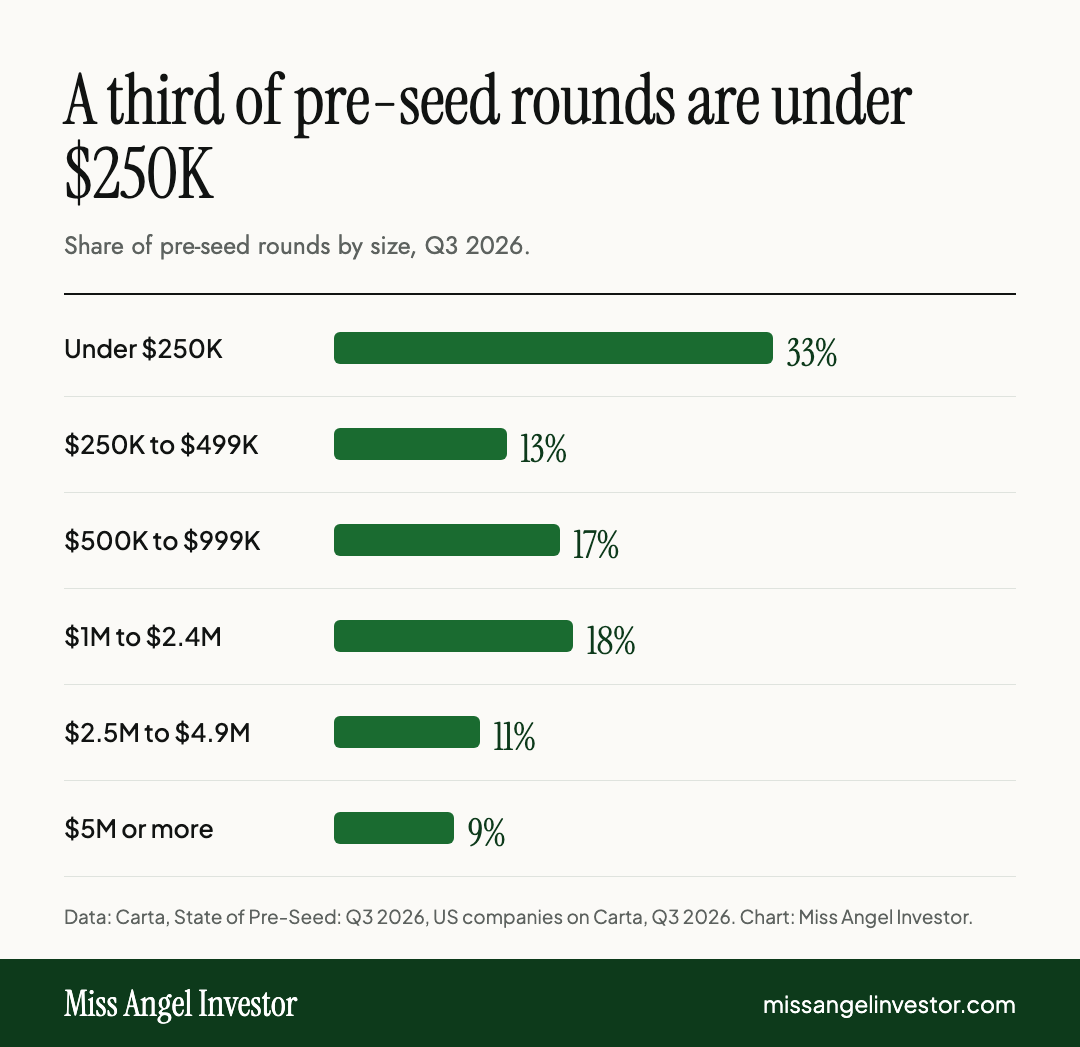
Carta's State of Pre-Seed: Q3 2026 shows what the room looks like. Rounds under $250K were 33% of pre-seed rounds in Q3 2026, the largest group. Rounds above $1M were 39% of pre-seed rounds over Q1 to Q3 2026.
Your ask also moves your cap. In Carta's data, bigger rounds carry bigger caps. The median cap on a $2.5M or larger deal rose 33% in a year, from $30M in Q3 2025 to $40M in Q3 2026. The median cap went up year over year for every round size.
The asks I trust sound like this: I need this amount to reach this milestone, then this amount to reach the next one.
One founder I backed was already making money. They raised to move faster and be first in their category. That made me lean in.
03How this works
- Name the milestone. The proof that makes your next round easy: a revenue number, a retention curve, a launch.
- Cost the plan. Team, product and go-to-market to reach it, month by month.
- Add runway. The next raise takes months and things slip, so build in a buffer beyond the milestone date.
- Divide by the cap. On a post-money SAFE, ownership sold equals the amount raised divided by the cap. Check that number before you name your ask.
Carta defines pre-seed as money raised on SAFEs or convertible notes before a company's first priced round. It defines a round as all the instruments a company raised at the same valuation cap.
What caps look like right now
These are Carta's median post-money SAFE caps from Q1 2025 to Q3 2026, by round size.
| You raise | 25th percentile | Median | 75th percentile |
|---|---|---|---|
| Under $250K | $5M | $8M | $12M |
| $250K to $499K | $6M | $10M | $16M |
| $500K to $999K | $7M | $10M | $20M |
| $1M to $2.4M | $10M | $15M | $25M |
| $2.5M or more | $20M | $30M | $50M |
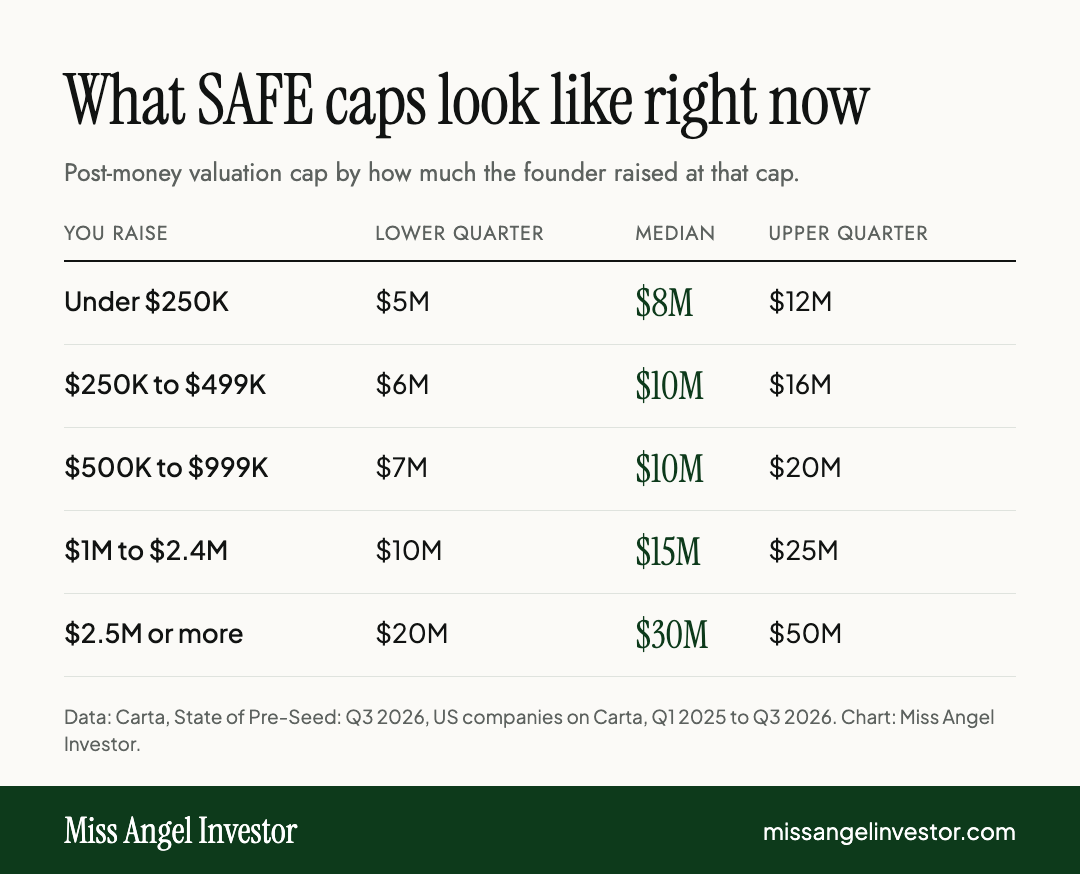
Carta notes that much of this capital is going to AI startups in California. Healthtech, biotech and fintech typically see lower caps. Read your row of the table with your sector in mind.
Carta also reports the median expected dilution from post-money SAFEs, by the size of the founder's latest SAFE round.
| Latest SAFE round | Median expected dilution |
|---|---|
| $500K to $999K | 10.2% |
| $1M to $2.4M | 16.7% |
| $2.5M to $4.9M | 20.2% |
Your ask and your cap move together. Pick the ask first, then check your cap against the row that matches it.
What a priced seed round looks like in your sector
Once you raise a priced seed, the ask and the valuation come as a pair. These are the medians for priced seed rounds across Q3 2021 to Q3 2026, from Carta's round benchmarking tool.
| Sector | Median seed round | Median post-money valuation | Median share sold |
|---|---|---|---|
| Medical devices | $2.5M | $12.9M | 20.0% |
| Consumer | $3.0M | $15.6M | 20.0% |
| Healthtech | $3.5M | $16.9M | 20.7% |
| SaaS | $3.9M | $19.6M | 20.1% |
| Fintech | $4.0M | $20.2M | 20.4% |
| Energy | $4.4M | $18.0M | 23.6% |
| Biotech | $4.5M | $18.6M | 25.5% |
| Hardware | $4.7M | $21.5M | 21.1% |
In every sector the median founder sells 20% or more at the seed. Add that to what your SAFEs already cost you.
The math, with made-up numbers
Say your plan costs $25K a month, the milestone takes 18 months, and you add 2 months of buffer.
- 20 months times $25K is $500K. That is your ask.
- $500K lands in the $500K to $999K row. The median cap is $10M.
- $500K divided by $10M is 5%. You sell 5%.
Now run it across the row. At the 25th percentile cap of $7M, the same $500K sells 7.1%. At the 75th percentile cap of $20M, it sells 2.5%.
Next, test the amount against the cap. A $30M cap on a $500K round would sell 1.7%. Three quarters of rounds that size closed at a cap of $20M or less, so a cap that high needs a reason you can show.
Then test a bigger ask. Say investors are interested and you decide to raise $1M. That row has a median cap of $15M. $1M divided by $15M is 6.7%. You sell 1.7 points more, and your next round has to beat a $15M cap.
Finally, add the 5% to every other SAFE you have signed. Carta's median expected dilution for founders whose latest SAFE round was $500K to $999K is 10.2%, about double that single SAFE. That total is the number to watch, because it is the one that grows past 20% when nobody adds it up.
04Try it with AI
Copy this prompt into Claude or ChatGPT, fill in the brackets and run it on your own company.
Here is my monthly budget for the next 24 months: [paste]. Here is the milestone I need for my next round: [milestone]. Tell me the minimum and comfortable raise amounts, and the dilution each implies at a post-money cap of [$X].
Data: Carta, State of Pre-Seed: Q3 2026, by Hamza Shad, US companies on Carta. Carta round benchmarking tool, Q3 2021 to Q3 2026.
Educational content, not legal, tax or financial advice.
Want help applying this to your company? Yearly 1:1 coaching, by application.
Work with me →The 6 numbers investors ask for: burn, runway, CAC, LTV, payback, margin
Know these six numbers cold before your first meeting. They are how investors check whether your story holds.
Raise moneyDelaware C-Corp: when Latin American founders need a US company
California took 64% of US pre-seed cash in Q3 2026. If you want that money, here is the structure US investors expect and what to settle with a lawyer first.