 Angie Carrillo
The 6 numbers investors ask for: burn, runway, CAC, LTV, payback, margin
Know these six numbers cold before your first meeting. They are how investors check whether your story holds.
01The question on every founder's mind
Which numbers do I need to know before I walk into the room?
02My position
Your story gets you the meeting, and your numbers decide whether there is a second one.
Investors invest in lines. One number tells them where you are. The same number over several months tells them where you are going, and that is what they are buying. The numbers founders know least are the ones tied to customer acquisition: CAC, monthly recurring revenue, and how much they are raising against which milestones.
What helped me most was tying every number to a milestone. Here is what we already achieved without money, or with a grant, and here is what we will do with this round. The asks I trust sound like this: I need this money to get to this milestone, then this amount to get to the next one. That turns your numbers into a line that keeps going up, and it shows an investor you deliver before you ask.
Nobody has every number in their head. When a founder pauses, checks their notes and says, "I don't have that number, I'll get back to you," and does within the hour, that works for me. It's honest, and we've all been there.
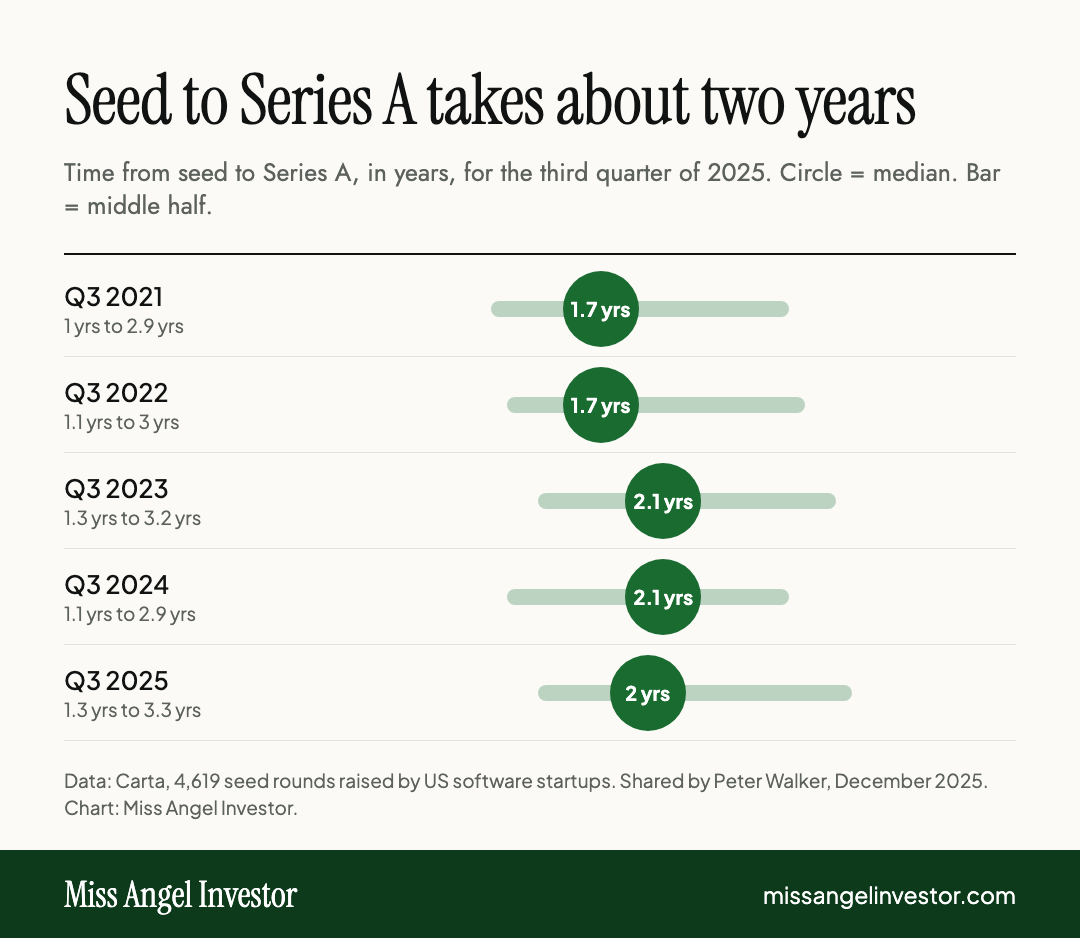
Runway is the number with the clearest receipt. In Carta's data on 4,619 seed rounds raised by US software startups from 2021 to 2025, the median time from seed to Series A was 2.0 years in Q3 2025. The 25th percentile was 1.3 years and the 75th percentile was 3.3 years. The old advice of 18 to 24 months sits at the short end of that range. Peter Walker, who shared the data, suggests planning for 1,000 days right now. That is his planning benchmark, an opinion, and Carta does not publish it as a measured figure.
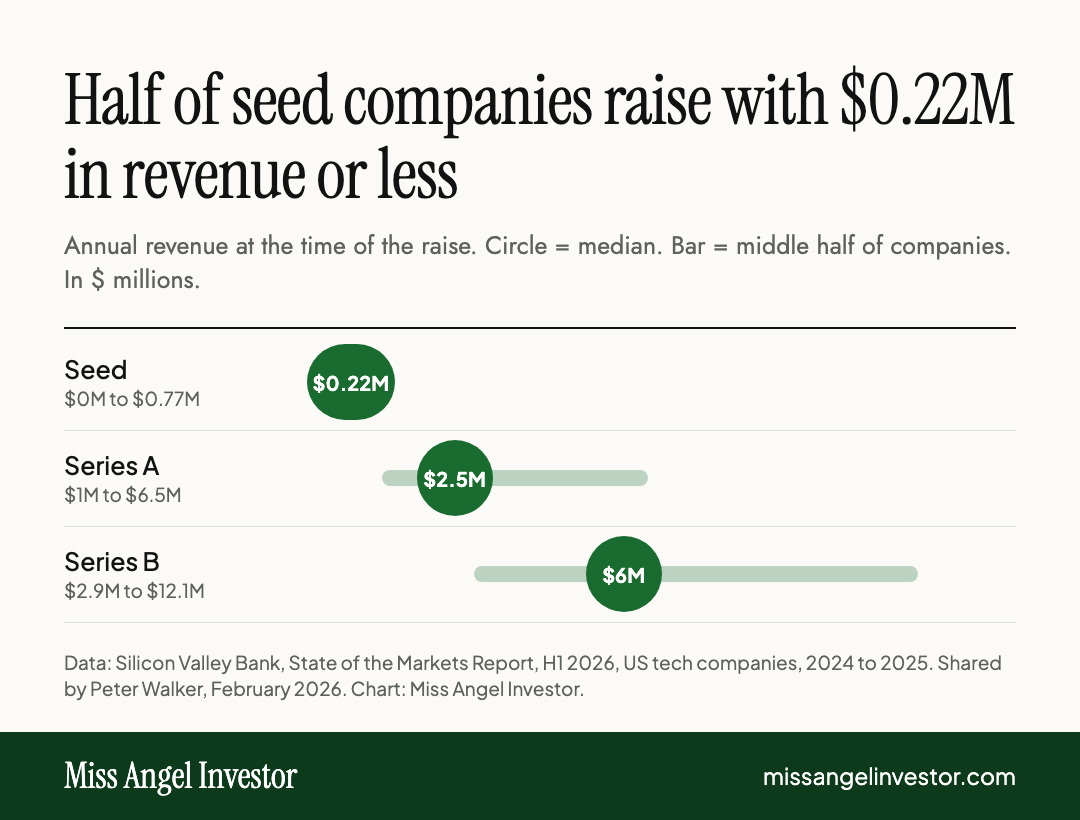
Revenue is the second receipt. Below is revenue at the time of raise for US tech companies in 2024 and 2025, from Silicon Valley Bank's State of the Markets Report, H1 2026, in a chart shared by Peter Walker. At seed the 25th percentile is $0.00M and the median is $0.22M. The jump from median seed to median Series A is 11.3x.
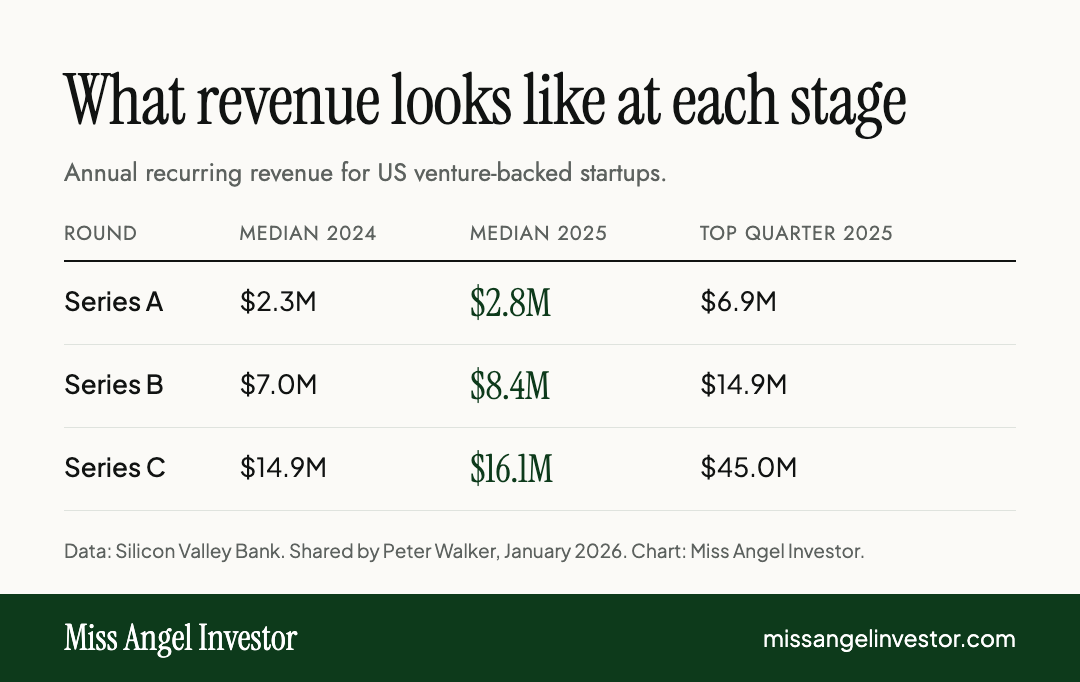
Series A medians have climbed as well. Peter Walker puts the 2021 median Series A ARR at about $1M. Silicon Valley Bank data for US VC-backed startups puts it at $2.3M in 2024 and $2.8M in 2025, up 22% year over year. Growth rate carries weight next to the absolute number, so write down how you define ARR. Peter Walker's advice: growth rate counts next to the absolute number, and you should never take your best month and multiply it by 12.
03How this works
Think of the six numbers as one story. It tells an investor how much it costs to win a customer, how much that customer is worth, how fast you get your money back and how long you can keep going. When the story holds, more capital speeds it up, and a broken one loses money faster.
The six numbers
- Burn. Cash you lose each month. Net burn is cash out minus cash in.
- Runway. Cash in the bank divided by net burn. It tells an investor how long you survive and how much leverage you have.
- CAC. Sales and marketing spend in a period divided by new customers won in it.
- LTV. Gross profit a customer brings over the whole relationship. A common rule of thumb, not data: LTV at least three times CAC.
- Payback. Months to earn back what you spent to win a customer.
- Gross margin. Revenue minus direct delivery costs, as a percentage. A common rule of thumb, not data: software margins of 70% or more.
Revenue at the time of raise, by stage
US tech companies, 2024 to 2025. Source: Silicon Valley Bank, State of the Markets Report, H1 2026, as shown in a chart shared by Peter Walker.
| Stage | Median | 75th percentile | 90th percentile |
|---|---|---|---|
| Seed | $0.22M | $0.77M | $3.60M |
| Series A | $2.50M | $6.50M | $11.40M |
| Series B | $6.00M | $12.10M | $28.00M |
Revenue is one input. Peter Walker points out that bio, energy and hardware companies often need cash before revenue starts, so if you build one of those, pitch investors who back your type of company.
The math, with made-up numbers
Say you run a SaaS company. Everything below is invented for the example.
- You earn $30K a month and spend $45K. Net burn is $15K.
- You have $300K in the bank. Runway is $300K divided by $15K, which is 20 months.
- You spend $20K a month on sales and marketing and win 40 customers. CAC is $500.
- Each customer pays $100 a month at 80% gross margin, so you keep $80 a month. They stay 30 months. LTV is $2,400.
- LTV divided by CAC is 4.8. Payback is $500 divided by $80, which is 6.25 months.
Now take it one step further, with Carta and SVB next to your own numbers.
Your 20 months of runway is 4 months short of the 24-month median from seed to Series A. To close it, grow revenue faster, cut burn or raise more.
Your $30K a month, if all of it recurs, is $360K of ARR. In the seed chart that sits between the 55th percentile at $0.35M and the 60th at $0.40M. Your story at a seed raise has revenue behind it, and the line from this month to the next is what you show the investor.
04Try it with AI
Copy this prompt into Claude or ChatGPT, fill in the brackets and run it on your own company.
Here are my last 6 months of revenue, costs and customer counts: [paste]. Calculate my net burn, runway, CAC, LTV, payback and gross margin, show the formula for each, and flag the weakest one an investor will ask about.
Data: Carta, shared by Peter Walker, Seed to Series A timing, 2025-12-12. Silicon Valley Bank, State of the Markets Report, H1 2026, shared by Peter Walker: revenue at time of raise by stage, 2026-02-06, Series A ARR, 2026-01-06. Revenue figures come from Silicon Valley Bank, State of the Markets Report, H1 2026.
Educational content, not legal, tax or financial advice.
Want help applying this to your company? Yearly 1:1 coaching, by application.
Work with me →Delaware C-Corp: when Latin American founders need a US company
California took 64% of US pre-seed cash in Q3 2026. If you want that money, here is the structure US investors expect and what to settle with a lawyer first.
Raise moneyThe data room checklist: be ready before due diligence
A clean data room speeds up your close and signals that you run a tight company. Build it before the first meeting.