 Angie Carrillo
Delaware C-Corp: when Latin American founders need a US company
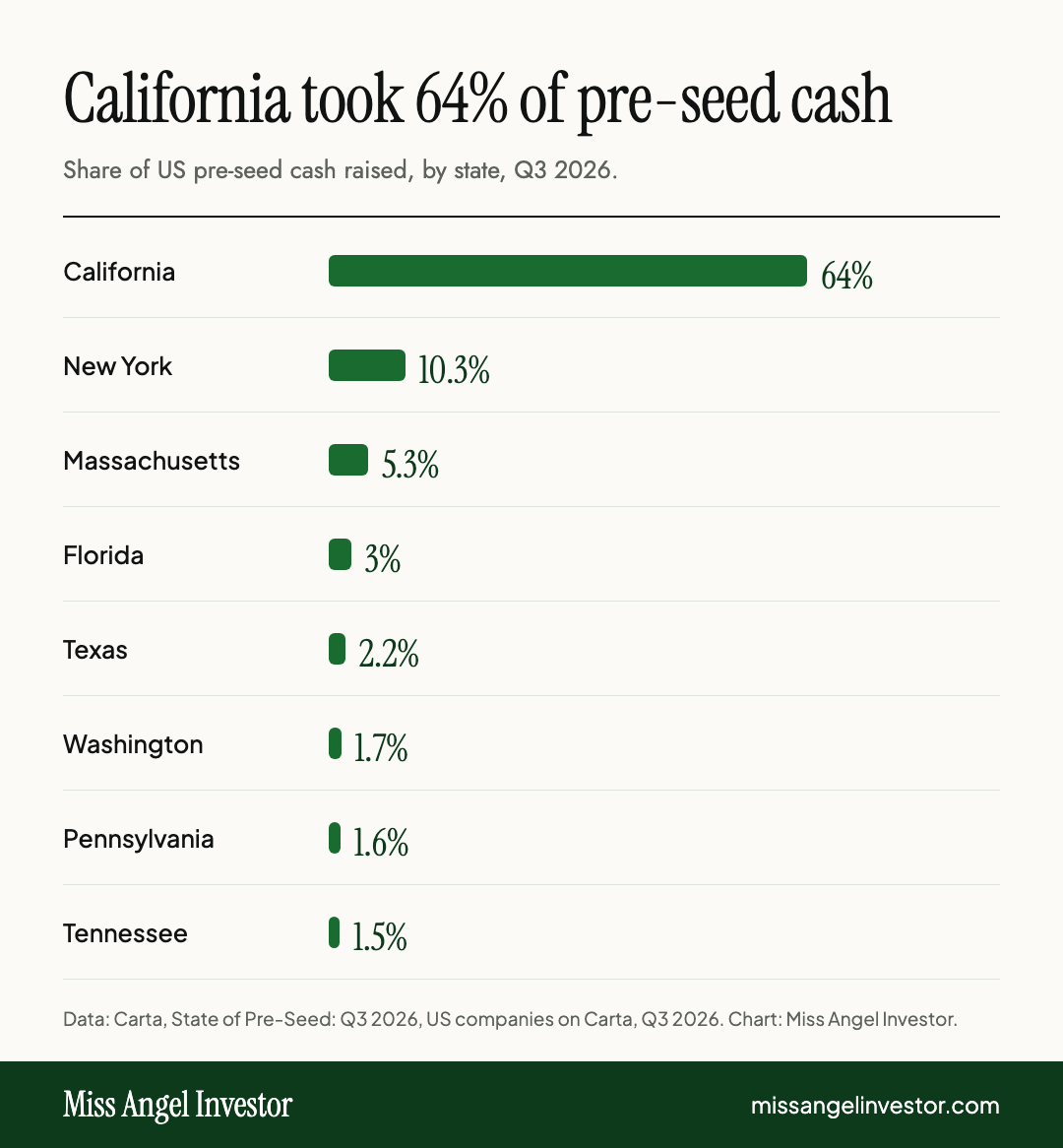
California took 64% of US pre-seed cash in Q3 2026. If you want that money, here is the structure US investors expect and what to settle with a lawyer first.
01The question on every founder's mind
Do I need a US company to raise from US investors?
02My position
If you want US venture money, use the structure US investors expect.
I prefer the Delaware C-Corp, because it's the standard. Other structures exist, like the Cayman sandwich, and some funds invest in those. The funds I've seen only invest in Delaware C-Corps, and it makes everything easier for you. If you want hypergrowth and venture backing, set up a Delaware C-Corp.
Many founders start local and flip later. The US company becomes the parent and the local company becomes its subsidiary. A flip costs more and takes longer than setting up right the first time, and it often happens in the middle of a raise, when you have the least time for it. Decide early if venture is your path.
US startup capital sits in very few places, and Carta's data shows how few. In State of Pre-Seed: Q3 2026, California took 64% of US pre-seed cash in Q3 2026, about $2.0B. New York took about 10%. The Bay Area alone raised $1.7B, five times the next biggest metro area. The Western census region took 68% of pre-seed dollars in Q3, up from 58% the quarter before.
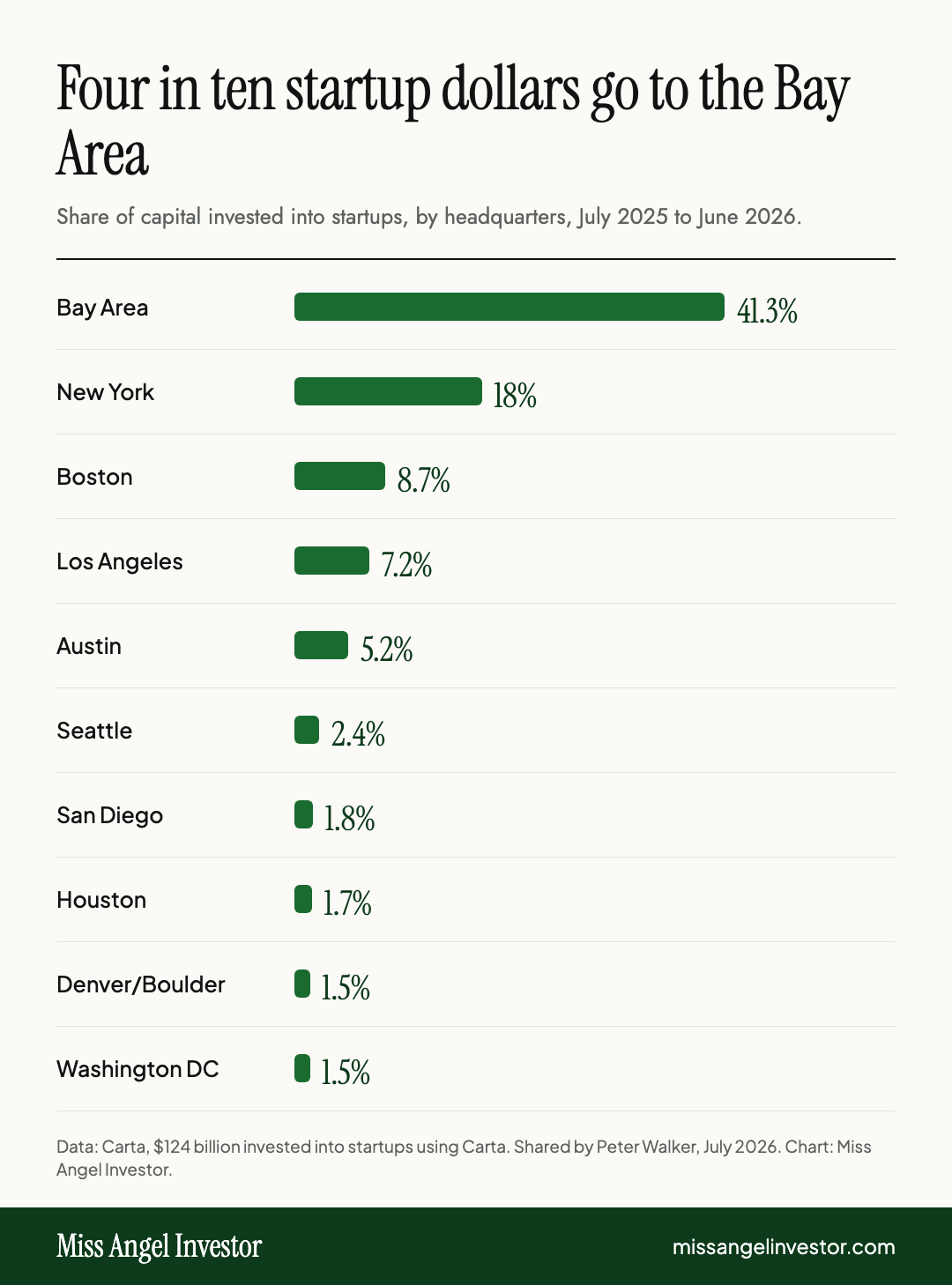
The wider picture looks the same. Carta data shared by Peter Walker tracks $124 billion invested into startups using Carta from July 2025 to June 2026. It ranks each location by total capital invested into startups with a headquarters there. Here are the top ten and their share of all that capital.
| Rank | Location | Share of the $124B |
|---|---|---|
| 1 | Bay Area | 41.3% |
| 2 | New York | 18.0% |
| 3 | Boston | 8.7% |
| 4 | Los Angeles | 7.2% |
| 5 | Austin | 5.2% |
| 6 | Seattle | 2.4% |
| 7 | San Diego | 1.8% |
| 8 | Houston | 1.7% |
| 9 | Denver/Boulder | 1.5% |
| 10 | DC | 1.5% |
These investors and their lawyers work with one structure all day.
I once looked at a company based outside the US that was raising through a syndicate. I liked the founder and what she was building. I still passed. I'm already a foreigner investing in the US, and I didn't want to add another layer of complexity.
03How this works
Most US funds and accelerators expect a Delaware C-Corp, because Delaware corporate law is predictable and familiar to every investor and lawyer in the market. Their fund documents, standard terms and lawyers all assume it.
When you need it
- You're raising from US funds or applying to US accelerators.
- You're selling to US customers and want to sign as a US company.
- You plan to issue stock options to a team in several countries.
When you can wait
- You're on the monetize path, selling locally and funding growth with revenue.
- Your first capital comes from local angels comfortable with your local entity.
Set up right from day one
- Founder vesting. Four years with a one-year cliff is the standard investors expect.
- The 83(b) election. If your founder shares vest, file it with the IRS within 30 days of receiving them. Miss the window and you may owe tax as your shares vest and grow in value.
- Clean IP. Every founder and contractor assigns their work to the company in writing.
Y Combinator publishes its standard SAFEs for US companies on its SAFE page. It also publishes valuation cap versions for companies formed in Canada, the Cayman Islands and Singapore, and tells founders to use those with a lawyer licensed in that country. If your company sits outside the US, the form you sign is a question for a lawyer too.
The checklist: settle these with a startup lawyer before your first US investor meeting
- Do I need a Delaware C-Corp now, or can I wait until someone wants to invest?
- If I'm already incorporated at home, what would a flip involve for my country, and what would it cost me in time and money?
- Do the funds I'm targeting invest in my current structure, or only in Delaware C-Corps?
- Is vesting in place for every founder, with four years and a one-year cliff?
- If your founder shares vest, was the 83(b) election filed with the IRS within 30 days of receiving them?
- Has every founder and contractor assigned their work to the company in writing?
- If I plan to give stock options to a team in several countries, what do I need in place first?
- If my company is formed outside the US, can I use a YC SAFE at all, and which version?
- What has to be finished before I take the first check?
Bring this list to the first call and ask for each answer in writing.
This guide is educational, not legal or tax advice. Use it to ask a startup lawyer better questions, and get the structure reviewed before you take your first check.
04Try it with AI
Copy this prompt into Claude or ChatGPT, fill in the brackets and run it on your own company.
I'm a founder based in [country] building [one-line company]. My customers are in [markets] and I plan to raise from [local angels / US funds / both] in the next [months]. Explain whether I need a Delaware C-Corp now or later, what a flip would involve for my country, and the questions I should ask a startup lawyer in our first call.
Data: Carta, State of Pre-Seed: Q3 2026, by Hamza Shad. Carta Startup Ecosystem Leaderboard, shared by Peter Walker. SAFE documents: Y Combinator.
Educational content, not legal, tax or financial advice.
Want help applying this to your company? Yearly 1:1 coaching, by application.
Work with me →The data room checklist: be ready before due diligence
A clean data room speeds up your close and signals that you run a tight company. Build it before the first meeting.
Raise moneyThe pitch deck investors read
Ten slides, one story. The order that works, and what each slide has to prove.