 Angie Carrillo
Your one-liner: what you do, for whom, in one sentence
If you can't say it in one sentence, investors can't repeat it to their partners. Here is the formula.
01The question on every founder's mind
How do I explain my company so investors remember it?
02My position
Your one-liner is the sentence an investor repeats to their partners when you're not in the room.
Most founders write theirs for themselves, full of the features they're proud of. Investors listen for who pays, what changes for them, how and what proves it.
On the selection side at Draper University, the founders who stood out could explain their company in one breath. The ones who needed three minutes rarely made it to a second conversation, however good the product was.
If your sentence needs the word "platform" to work, it isn't finished yet.
I remember a cybersecurity startup whose name I couldn't pronounce. After I heard it a few times it stuck, and I still remember it today. A hard name takes a while, and then it stays.
How few decks one pre-seed investor funded
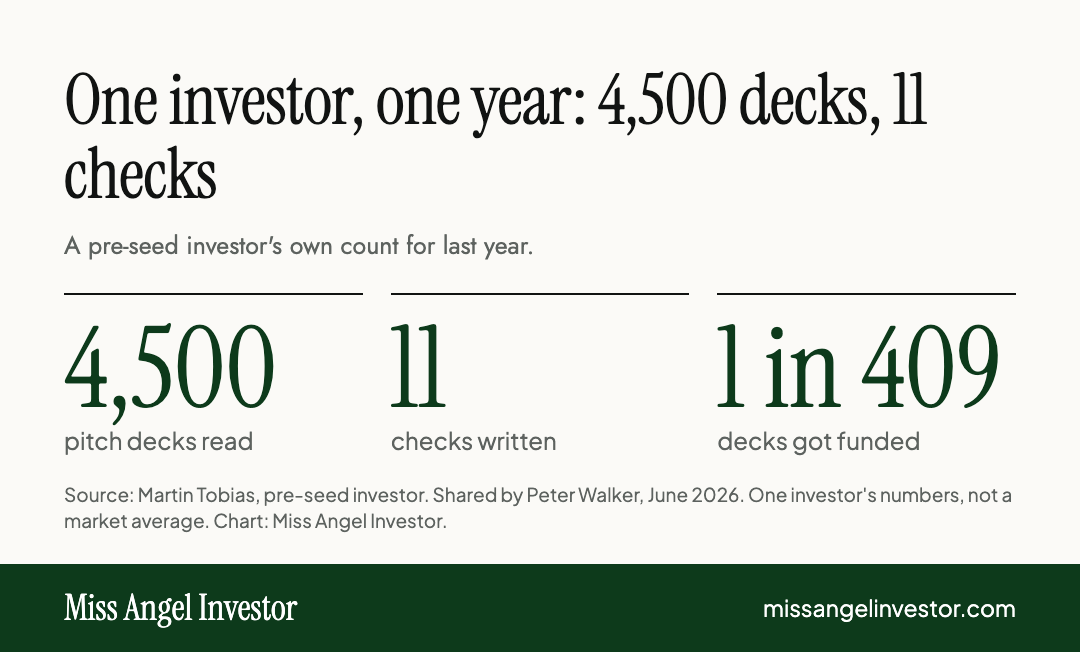
In a June 2026 post, pre-seed investor Martin Tobias said he looked at 4,500 decks last year and wrote 11 checks. Peter Walker, who led insights at Carta, called it a "0.2% deck-to-funding rate" and said it represents pre-seed and seed, even if it runs a little extreme. This is one investor's year. It shows the size of the pile your sentence lands in.
What the word AI tells an investor now
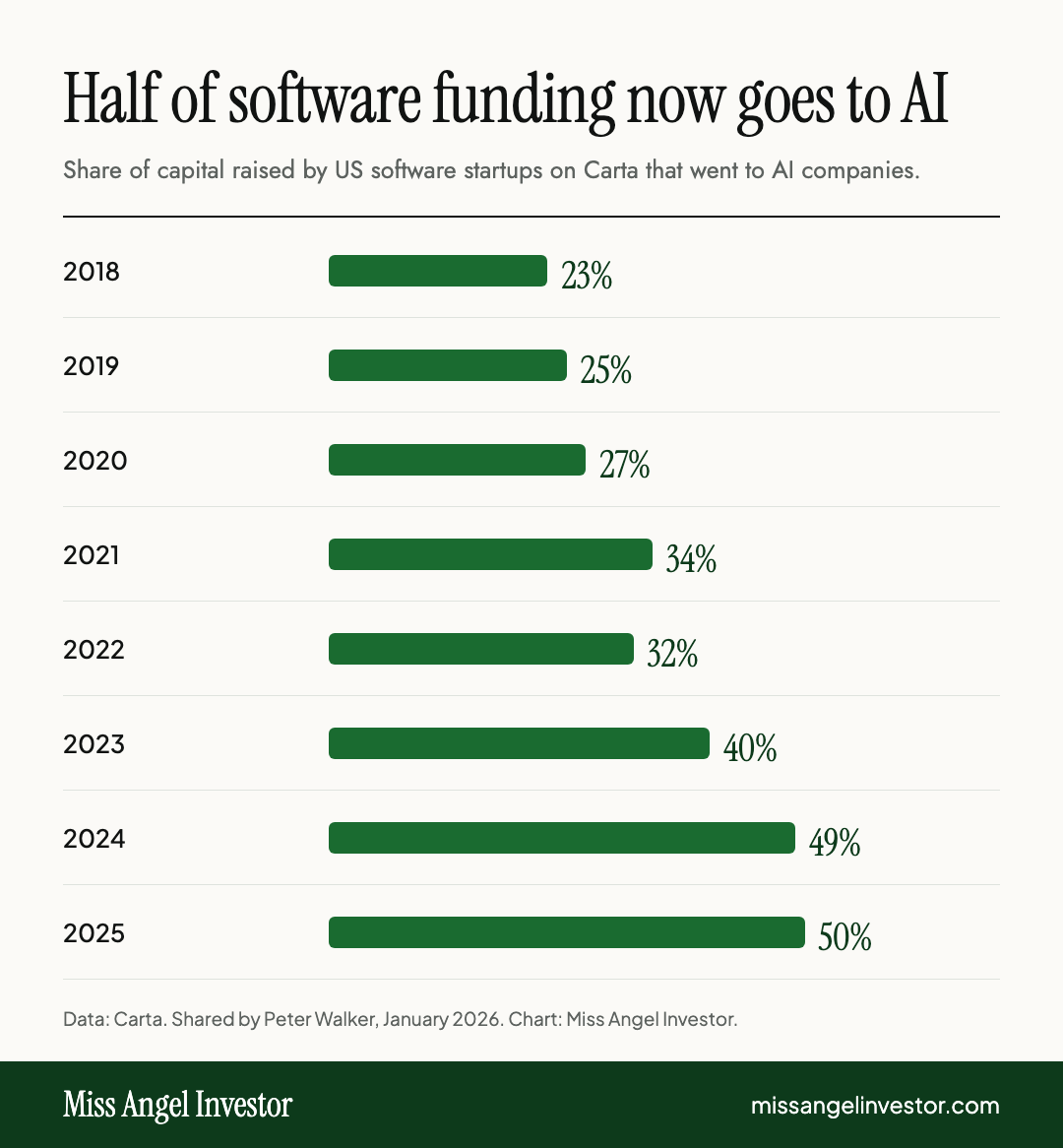
Carta data shared by Peter Walker in his January 2026 post covers US software startups on Carta. In 2025, 50% of the capital they raised went to AI companies. Without the massive late-stage raises, it is 48%. In 2018 it was 23%.
Half the money already goes to AI companies, so the word alone tells an investor nothing about yours. Lulu Cheng Meservey, speaking on TBPN, said people are fatigued by the AI buzzwords and want to hear what the product does, then see proof.
So the first sentence has to carry the company. It is the part an investor reads before deciding whether the rest earns their time.
03How this works
Test it this way: a partner who never met you repeats it in one breath.
Here is the formula:
We help [who pays] [what changes for them] by [how], and [proof].
Fill in the four slots
- Who pays. Name a customer you could find in a directory. "SMBs" is a category. "Independent pharmacies in Mexico" is a customer.
- What changes for them. One outcome. Hours saved or revenue added. Add a number when you have one.
- How. One method, in words your mom understands on the first try.
- Proof. A number you can show: customers or signed pilots. If you have none yet, leave this slot out and come back when you do.
The formula, filled in with made-up placeholders
Every detail below is invented to show the shape.
- Who pays: independent bakeries in Monterrey
- What changes: daily waste cut by 30%
- How: forecasting demand from their own sales
- Proof: 60 bakeries already use it
The sentence: We help independent bakeries in Monterrey cut daily waste by 30% by forecasting demand from their own sales, and 60 bakeries already use it.
Say yours out loud to someone outside your industry. Ask them to repeat it back. Whatever they drop was jargon.
04Try it with AI
Copy this prompt into Claude or ChatGPT, fill in the brackets and run it on your own company.
Here is what my company does, in as many words as I need: [paragraph]. Write 10 one-liners using the formula 'We help [who pays] [what changes for them] by [how], and [proof].' Then rank them by how easily an investor could repeat them to a partner, and explain why the top one wins.
Data: Carta data shared by Peter Walker, January 8, 2026. Deck and check counts: Martin Tobias, shared by Peter Walker, June 5, 2026.
Educational content, not legal, tax or financial advice.
Want help applying this to your company? Yearly 1:1 coaching, by application.
Work with me →