 Angie Carrillo
10 fundraising mistakes that cost founders their round
Ten avoidable mistakes, each with a fix you can apply this week.
01The question on every founder's mind
What makes rounds fail before the first pitch?
02My position
Most rounds die from avoidable mistakes long before an investor says no.
On the selection side at Draper University and while designing Fundraising School, I watched the same ten patterns repeat across founders, countries and sectors.
Two more I'd add to the ten. The first is taking things personally. As a founder I took every no personally. Some days I cancelled all my meetings because I was so devastated. It stopped being personal once I learned how it works on the investor's side.
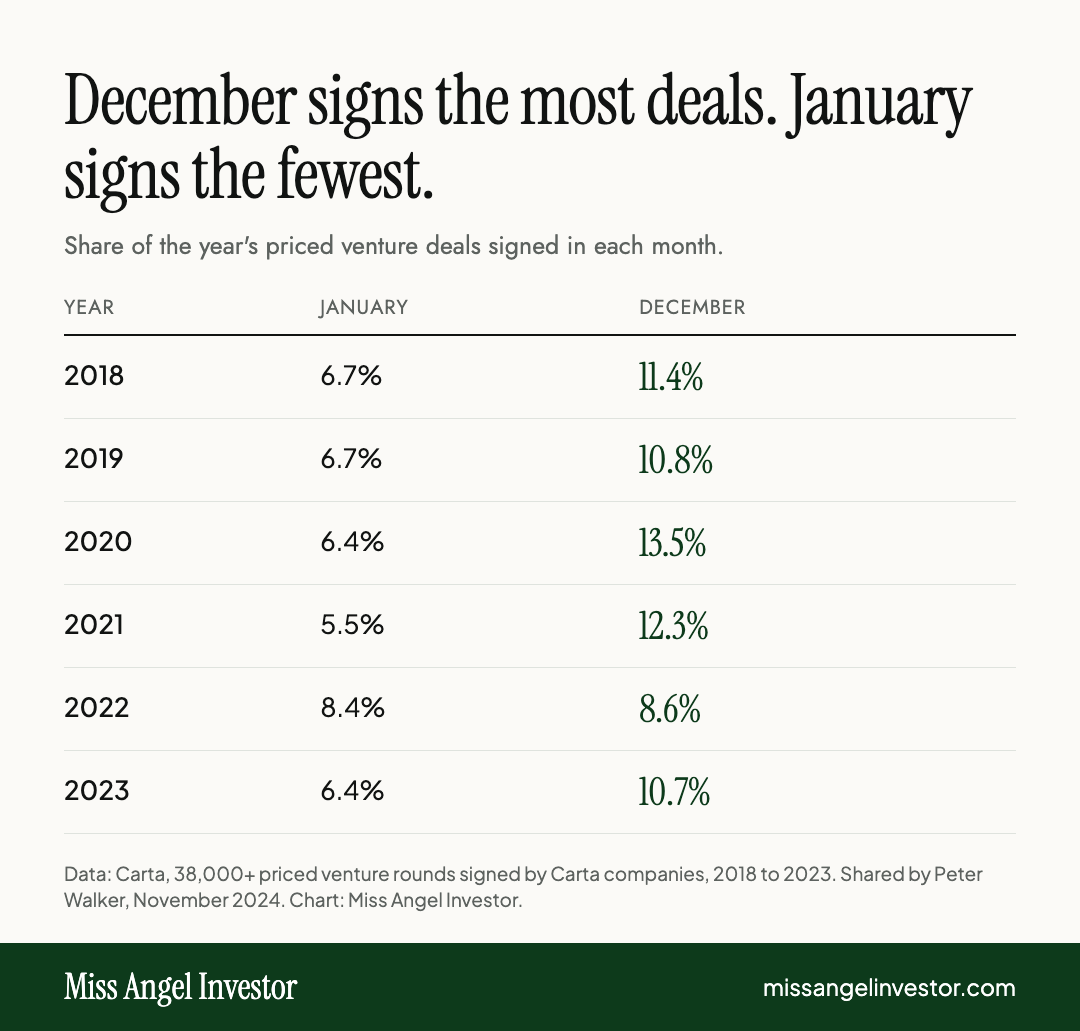
The second is raising at the wrong time of year. Carta data shared by Peter Walker, November 2024, covers 38,000+ priced venture rounds signed by Carta companies from 2018 to 2023. In five of those six years, December held 10.7% to 13.5% of the year's signed deals and January held 5.5% to 6.7%. December is for closing deals already in motion. Three focused weeks in January is when to run a raise. If it's almost December, get ready for next year.
Mistake 1 on the list below costs the most, because you can't undo it. Every warm intro you spend before you're ready is gone. Investors remember the version of you they met, and a "not yet" often becomes "we already looked at them" six months later.
The mistake I see most with SAFEs is founders who don't manage their SAFE math. They end up diluted by more than 20% before their priced round.
Mistake 6 has data behind it, below the list, with one more table on what a seed round costs today.
03How this works
The ten mistakes and their fixes
- Raising before you're ready. Warm intros don't come back. Prepare your one-liner, your numbers and your data room first.
- Raising when you should be selling. If revenue can come in six months, sell first. See the 6-month revenue rule.
- Pitching dream funds first. Your pitch is weakest at the start, so begin with specialist funds. See specialist funds first.
- Running a slow process. Spread meetings over months and every investor waits for the others. Compress them. See calendar density.
- Pitching the wrong investors. A fund whose usual check is bigger than your whole round won't lead it. Check the check size before you ask for the intro.
- Losing track of your SAFEs. Small checks on different caps add up fast. Keep one running total and update it with every signature. See SAFEs explained.
- Chasing the highest valuation. A valuation you can't grow into makes your next round harder. Pick the number you can beat at your next raise.
- Not knowing your numbers. Learn the 6 numbers investors ask and say them from memory.
- Outsourcing the raise. Investors back founders, and they want the story from you. Run the meetings yourself.
- Paying to pitch. A fee to get in front of investors is a warning sign. See red flags.
The data behind mistake 6, and what a seed costs
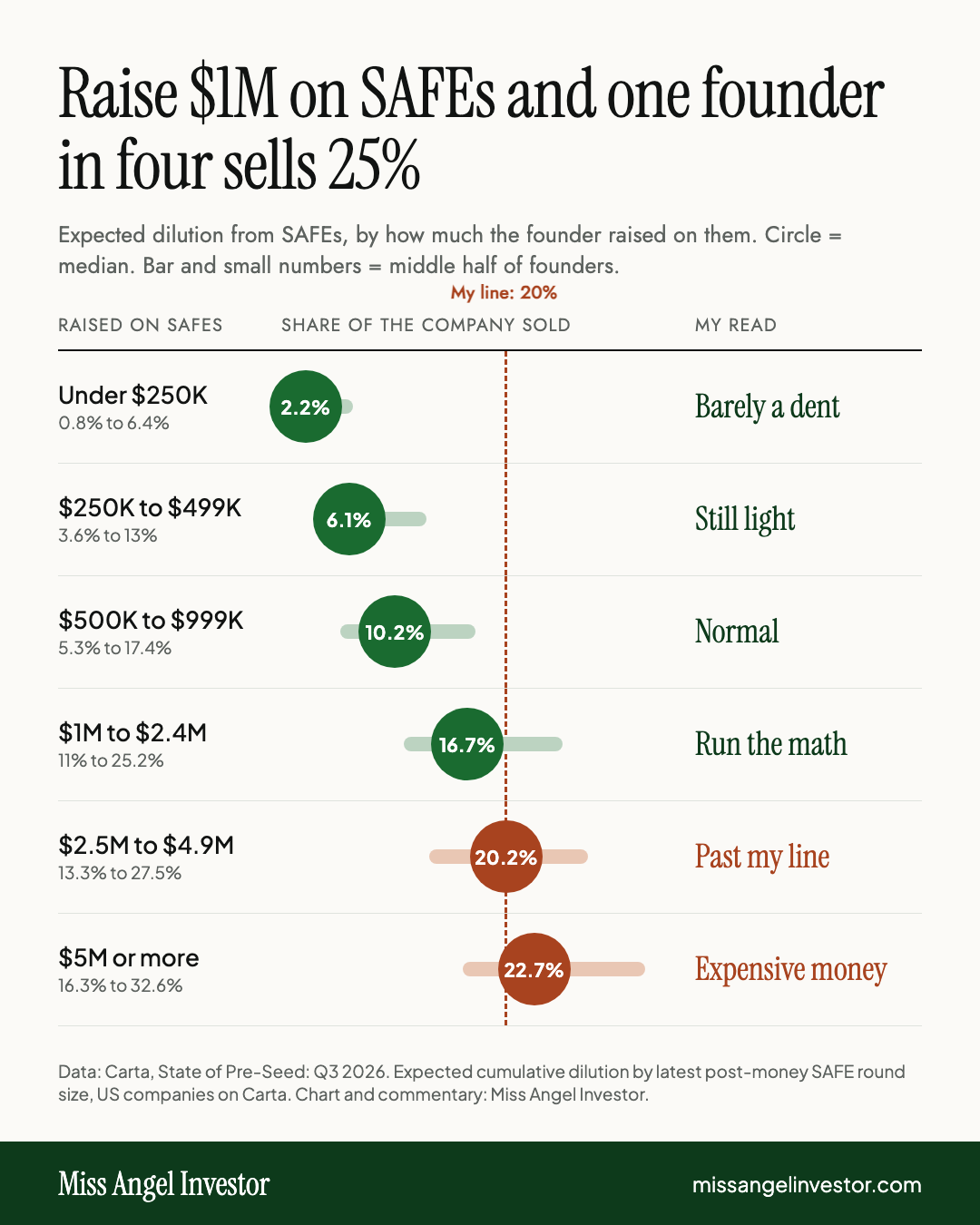
Stacking SAFEs without adding them up. Carta's State of Pre-Seed: Q3 2026 covers US companies on Carta. Carta defines pre-seed as money raised on SAFEs or convertible notes before a company's first priced round, and counts a round as all the instruments raised at the same valuation cap.
For founders whose latest SAFE round was $1M to $2.4M, the median expected cumulative dilution from post-money SAFEs is 16.7%. One in four is past 25.2%. At $2.5M to $4.9M the median is 20.2%, so the median founder there is already past the 20% I warn about, before the priced round.
A median round at one cap holds 7 SAFEs or notes at $1M to $2.4M and 10 at $2.5M to $4.9M.
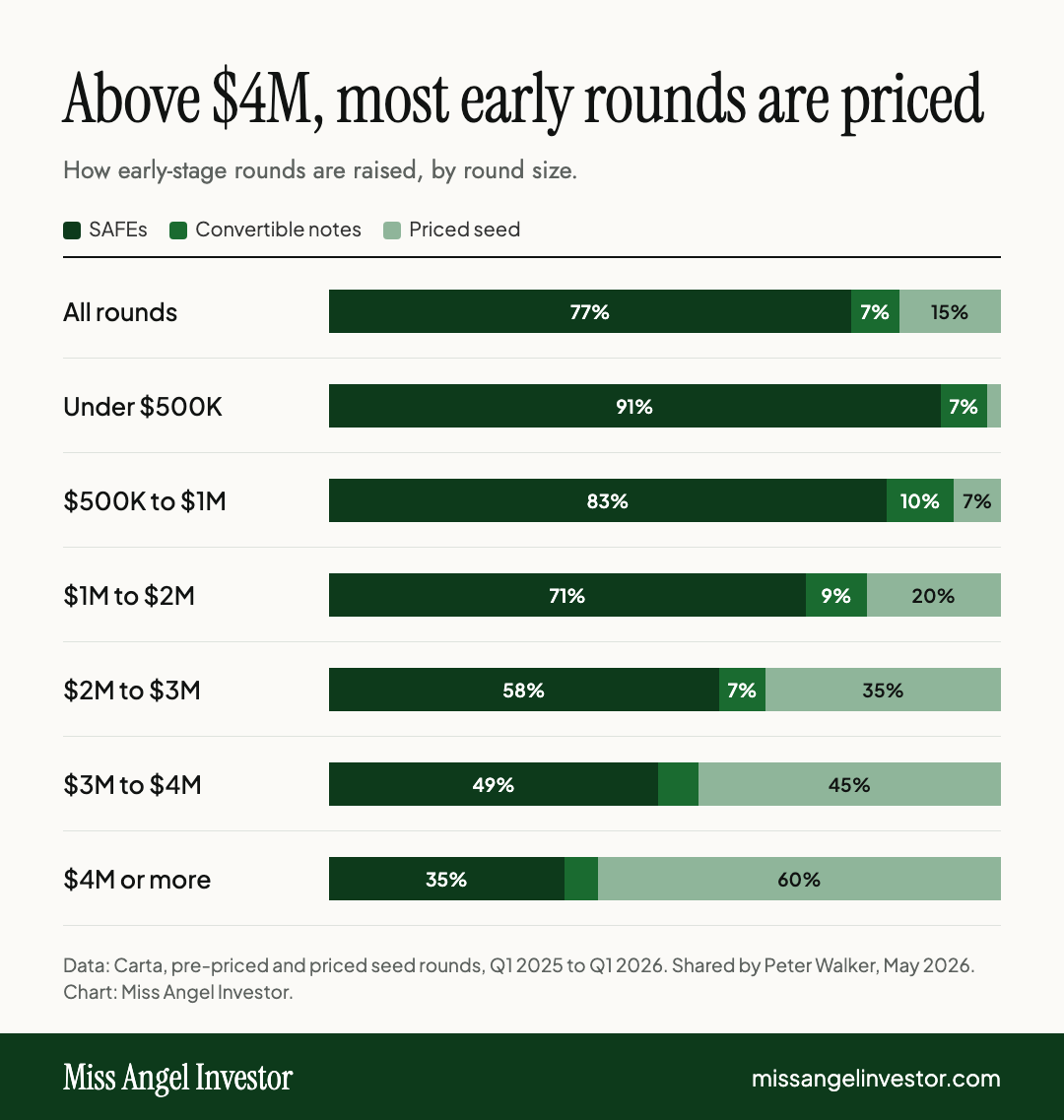
How early rounds are raised, by size. Carta data shared by Peter Walker, May 14, 2026, covers early-stage rounds, pre-priced and priced seed, from Q1 2025 to Q1 2026. He reports seeing as many as 8 different valuation caps before a first conversion.
| Round size | SAFEs | Convertible notes | Priced seed |
|---|---|---|---|
| All rounds | 77% | 7% | 15% |
| $500K to $1M | 83% | 10% | 7% |
| $1M to $2M | 71% | 9% | 20% |
| $2M to $3M | 58% | 7% | 35% |
| $3M to $4M | 49% | 6% | 45% |
| $4M+ | 35% | 5% | 60% |
Rounds under $500K were 91% SAFEs. Priced seed is 35% or more of rounds from $2M up.
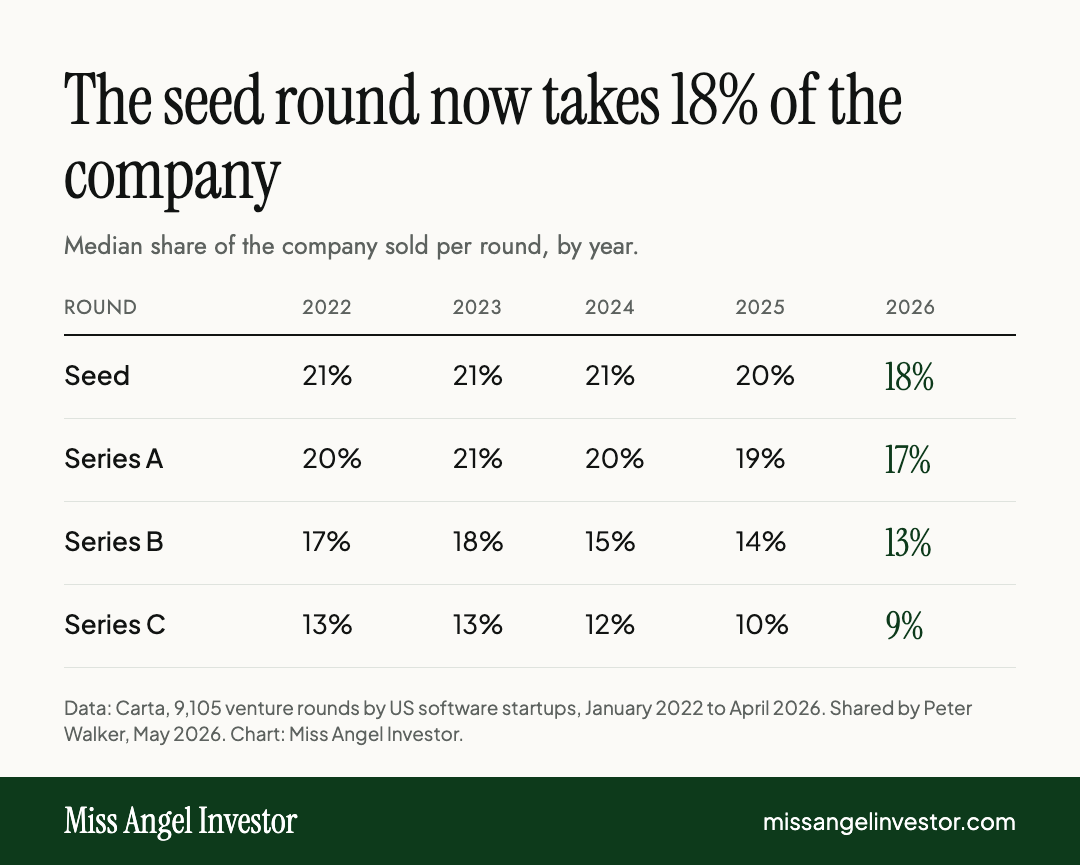
How much founders sell at the seed. Carta data shared by Peter Walker, May 11, 2026, covers 9,105 venture rounds on Carta from January 2022 to April 2026, US software startups only. It counts primary round dilution. Bridges and notes between rounds come on top.
| Year | Median share of company sold at seed |
|---|---|
| 2022 | 21% |
| 2023 | 21% |
| 2024 | 21% |
| 2025 | 20% |
| 2026 so far | 18% |
So far in 2026, the middle half of seed rounds sold between 12% and 22%. Sell what the next milestone needs. The asks I trust sound like this: "I need this money to get to this milestone, then this amount to get to the next one."
The self-check before you start
Mark each line done, at risk or not yet relevant. Fix every at-risk line before you send your first intro request.
- My one-liner, numbers and data room are ready.
- I have checked whether revenue can come in six months, and if it can, I sell first.
- My list starts with specialist funds.
- My meetings are packed into a short window.
- Every investor on my list writes checks near my round size.
- I have one total for every SAFE I have signed.
- I know which valuation I can grow into.
- I can say my numbers without notes.
- I am the one pitching.
- Nobody is charging me to meet investors.
04Try it with AI
Copy this prompt into Claude or ChatGPT, fill in the brackets and run it on your own company.
I'm about to start raising. Here is my situation: [stage, amount, traction, investor list, documents ready, SAFEs signed]. Run a pre-mortem: imagine the round failed in 3 months. Tell me which of these 10 mistakes is most likely to cause it and what to fix this week. The mistakes are: raising too early, should be selling, dream funds first, slow process, wrong investors, untracked SAFEs, chasing valuation, unknown numbers, outsourcing the raise, paying to pitch.
Data: Carta, State of Pre-Seed: Q3 2026, by Hamza Shad, US companies on Carta. Carta data shared by Peter Walker: November 2024, May 11, 2026, May 14, 2026.
Educational content, not legal, tax or financial advice.
Want help applying this to your company? Yearly 1:1 coaching, by application.
Work with me →Applying to Y Combinator: write for clarity and progress
A short application is easy to say yes to. Here is a before and after you can copy.
Raise moneyNegotiation and closing: the term sheet terms that matter
Valuation is one line on the term sheet. These are the other terms that decide what you take home, and how to close.