 Angie Carrillo
Applying to Y Combinator: write for clarity and progress
A short application is easy to say yes to. Here is a before and after you can copy.
01The question on every founder's mind
What does it take to get into Y Combinator?
02My position
A YC application wins on clarity and progress.
Y Combinator sits at the top of my list of aligned programs: it invests in you, and only wins when you win. I've also reviewed founders on the selection side at Draper University, and the lesson carries over. The applications that win make the decision easy for a tired reader.
At Draper University, the mistake I saw most was people who didn't try. What reviewers see now is AI slop: an application nobody edited, with no effort to hide that AI wrote it.
A no from YC will hurt, so plan for it. As a founder I took every no personally. Some days I cancelled all my meetings because I was so devastated. It stopped being personal once I learned how it works on the investor's side. If you get a no, treat it as information. Apply again when you have a clearly better number to show.
YC publishes the standard SAFE, and founders use it widely. Carta counted 8,762 SAFEs signed by US startups on its cap table in 2024, through late July, and 85% were post-money. YC made the post-money SAFE its standard in 2018, according to its SAFE page. By Q3 2026, 92% of SAFEs on Carta had a post-money cap, and 94% of pre-seed rounds used SAFEs.
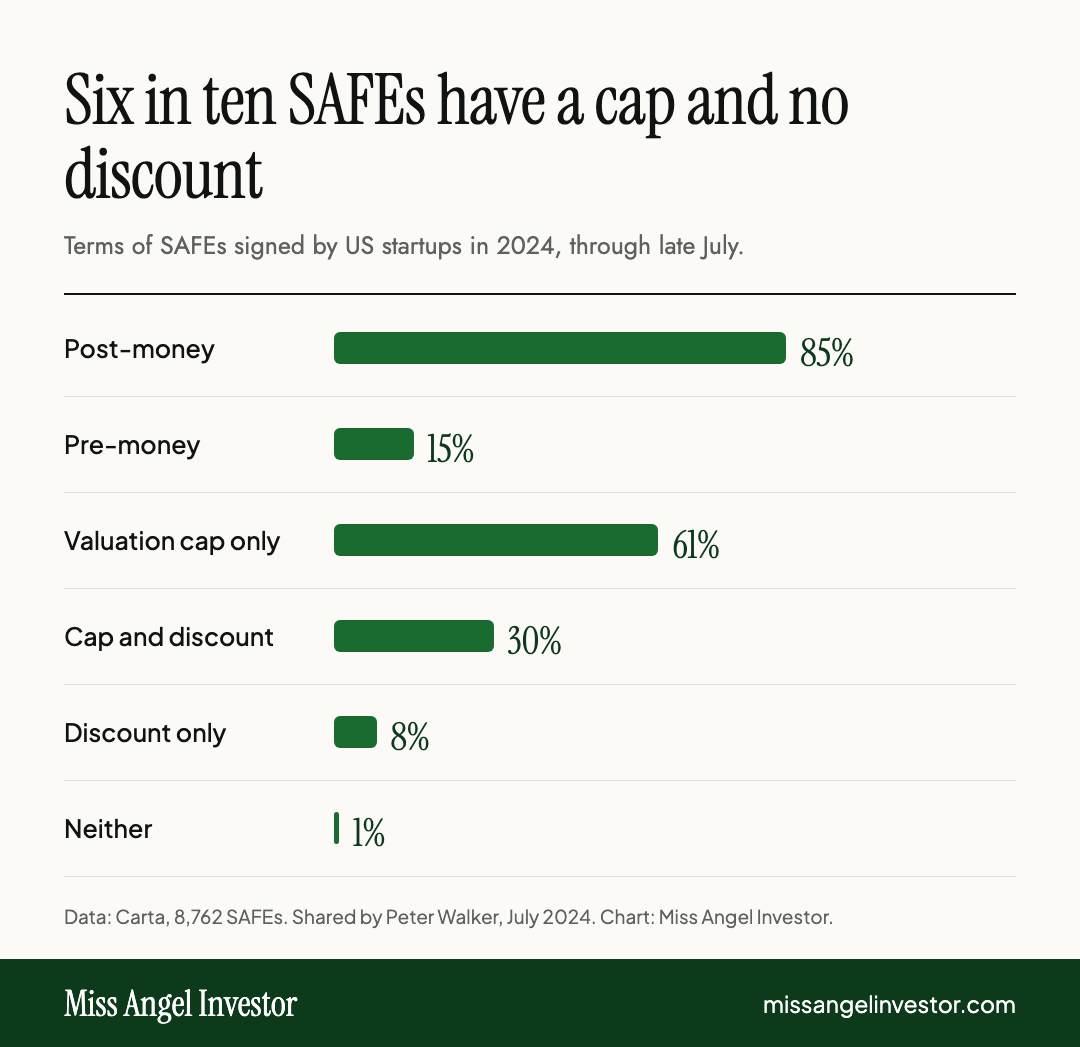
Source: Carta data shared by Peter Walker, post of July 30, 2024, and Carta's State of Pre-Seed: Q3 2026, US companies on Carta.
03How this works
Show four things on the page.
- Founders who build. Evidence that you ship fast, ideally with a technical founder on the team.
- Progress. Users, revenue, growth week over week, or a product people already rely on. Show the rate of change.
- Insight. Something you understand about the problem that others miss, usually because you lived it.
- A big enough market. Show the market is big enough to matter to a venture investor.
The framework
- Describe the company in plain words in the first line. Your one-liner does the job.
- Answer every question directly, with numbers wherever you have them.
- Record the founder video in one take: who you are, what you're building, why you.
- Practice a one-sentence answer to what you do, who uses it, how you grow and what you know that others don't.
- Check ycombinator.com for current deadlines and terms, since both change over time.
The math, with made-up numbers: a before and after you can copy
Every name and number below is made up. Swap in yours.
Before: "[COMPANY] is reimagining the future of [BIG INDUSTRY] through [TECHNOLOGY WORD]."
After: "We help [SPECIFIC CUSTOMER] do [SPECIFIC JOB]. [N] [CUSTOMERS] used us last month, up from [M] the month before."
Fill the After line with made-up numbers, 40 customers growing to 50. That is 10 more on a base of 40, so 25% growth. Hold that rate for three more months and 50 becomes about 98. Write the rate next to the raw numbers, because growth gives a reader the trajectory in one glance.
Then run the friend test. Send the After line to someone outside your industry. If they explain your company back to you correctly in two minutes, submit. If they cannot, rewrite the line.
The numbers behind this
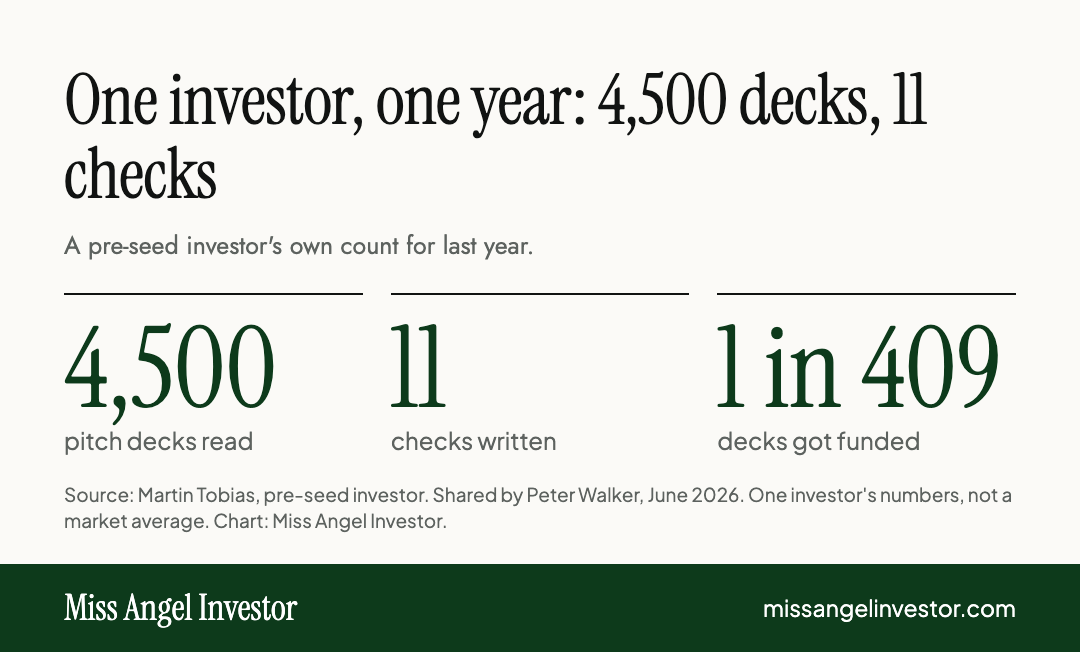
One pre-seed investor, Martin Tobias, looked at 4,500 decks in a year and wrote 11 checks, in a post by Peter Walker.
04Try it with AI
Copy this prompt into Claude or ChatGPT, fill in the brackets and run it on your own company.
Act as a Y Combinator partner reading a stack of applications today. Here is mine: [paste]. Tell me in two lines what my company does, whether I'd get an interview, my weakest answer, and the five questions you'd ask me in a short interview. Then give me a one-sentence answer for each.
Data: Carta data shared by Peter Walker, July 30, 2024. Carta, State of Pre-Seed: Q3 2026, US companies on Carta. SAFE documents: Y Combinator.
Educational content, not legal, tax or financial advice.
Want help applying this to your company? Yearly 1:1 coaching, by application.
Work with me →Negotiation and closing: the term sheet terms that matter
Valuation is one line on the term sheet. These are the other terms that decide what you take home, and how to close.
Raise moneyRead the no: what an investor's rejection is telling you
I took every single no personally. Then I saw how it works on the other side.