 Angie Carrillo
Your investor CRM: run your round like a sales pipeline
A round is a sales process with a deadline. Here is the tracker that keeps it moving.
01The question on every founder's mind
How do I keep a round moving when I'm talking to dozens of investors?
02My position
Run your round like a sales pipeline, with a tracker and a deadline.
Fundraising is a sales process. Investors are the buyers and your equity is the product. A founder who would never run a sales team without a pipeline still tries to run a round from memory and an inbox, and that is where rounds stall.
Most deals die from silence before anyone says no. An investor liked the meeting, you got busy, days turned into weeks and the moment passed.
After a meeting, an investor often says "keep us posted." Most founders never write again. The rare ones ask me, "Can I add you to my investor newsletter?"
Ankur Nagpal, Teachable and then Carry, was one of the few who always kept me posted. When his update bounced from my email, he told me. I call that a great sign, and a great example of how to follow up. A tracker makes that behavior ordinary, because every update you owe an investor is a row with a date.
Ankur writes about raising in his newsletter, Silly Money. In How to Think About Raising Venture Capital for your Startup he says sending reliable investor updates has been "incredibly worth it".
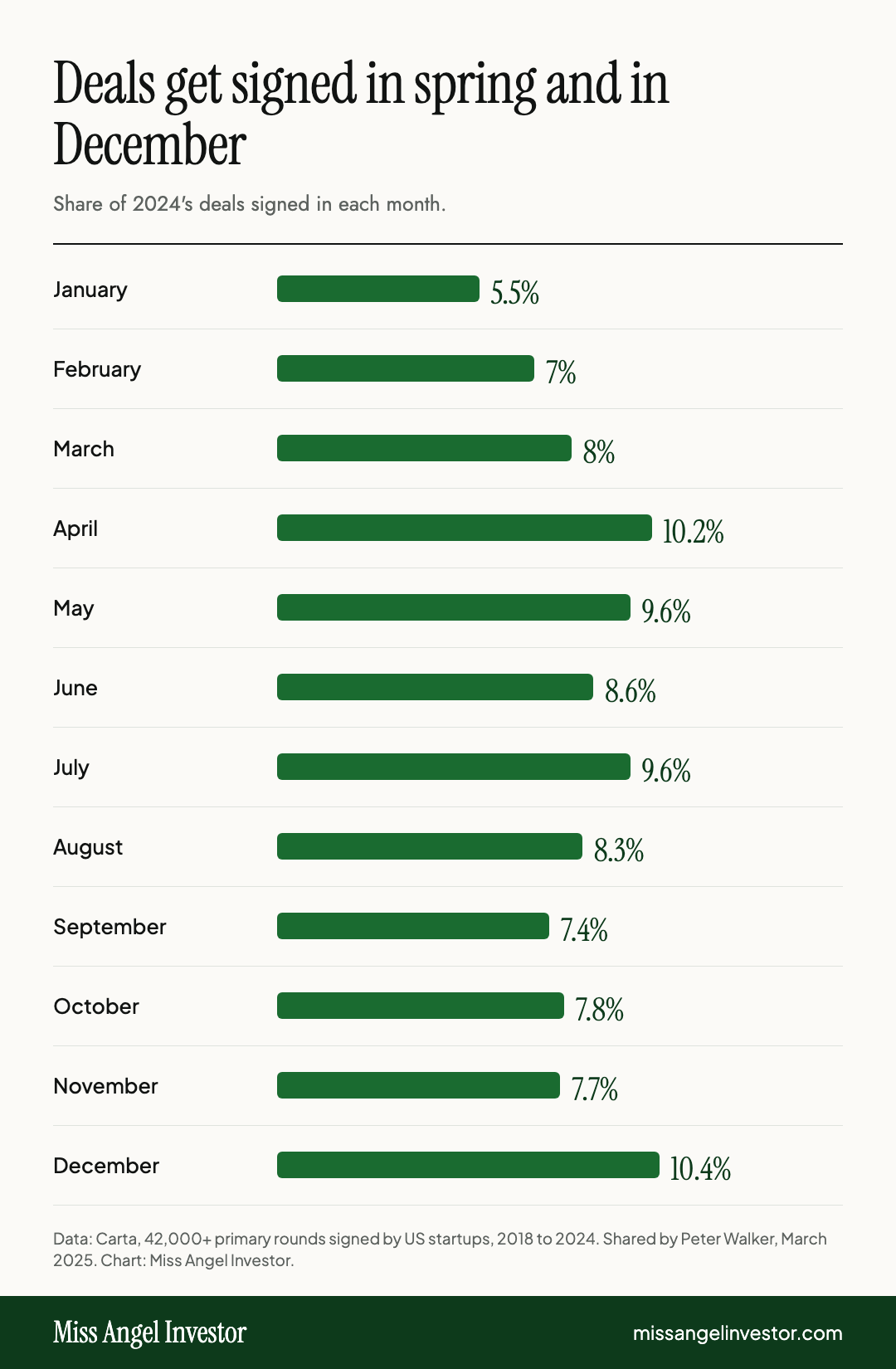
The dates matter because deals have a calendar. Carta data shared by Peter Walker covers more than 42,000 primary rounds signed by US startups on Carta from 2018 to 2024, and it shows what share of each year's deals were signed in each month. Carta dates each deal by its term sheet signature, which can land well before any announcement.
In 2024, January held 5.5% of the year's deals and April held 10.2%. December, at 10.4%, was the only month higher. Peter Walker notes that in 2023 and 2024, Q2 held more signed deals than any other quarter. A term sheet signature is the end of a pipeline, and your sheet needs the dates that lead up to it.
03How this works
Open a spreadsheet. One row per investor. A spreadsheet works, and the habit that makes it work is updating it daily and opening it every morning.
The columns
- Fund and partner name
- Tier: angel, specialist fund or dream fund
- Check size and stage they invest in
- Who can introduce you, and how warm that connection is
- Stage: researched, contacted, first meeting, deep dive, term sheet, closed or passed
- Last contact and next step, with a date
- What they asked, and what you sent back
Every row in an active stage has a next step and a date.
The daily and weekly routine
Each morning, sort the sheet by next step date and clear everything due that day before you open email.
Each Friday, count how many investors sit in each stage and look at where they stop. That count tells you what to fix. If most first meetings end before a deep dive, look at your pitch and your traction slide before you book more meetings.
The rules
- After every meeting, send what they asked for and log the date in the sheet.
- Add every investor who said "keep us posted" to an update list, with a date for your next update.
- Keep the details private. Never share which funds you're talking to, or who gave you terms.
- Ask every investor who passes for one piece of feedback and write it in the sheet. Their reason tells you what to fix before the next meeting.
- Book meetings close together, so investors decide on the same timeline. See calendar density.
The math, with made-up numbers
Say you put 40 investors in the sheet. 25 take a first meeting, 10 reach a deep dive and 3 send term sheets.
Your Friday count shows the biggest drop is between first meeting and deep dive. You lose 15 of your 25 first meetings there, 60%, the steepest drop of any stage. That is the stage to fix first.
Now add the deadline. You want a term sheet signed by June 30. Say your own history shows 2 weeks from first meeting to deep dive, 3 weeks from deep dive to term sheet and 2 weeks from term sheet to signature. That is 7 weeks, or 49 days.
Count back from June 30 and your last first meetings need to happen by May 12. An investor you have not met by then is unlikely to sign by June 30 in this pipeline. With dates in the sheet, you see that gap in April.
The numbers behind this
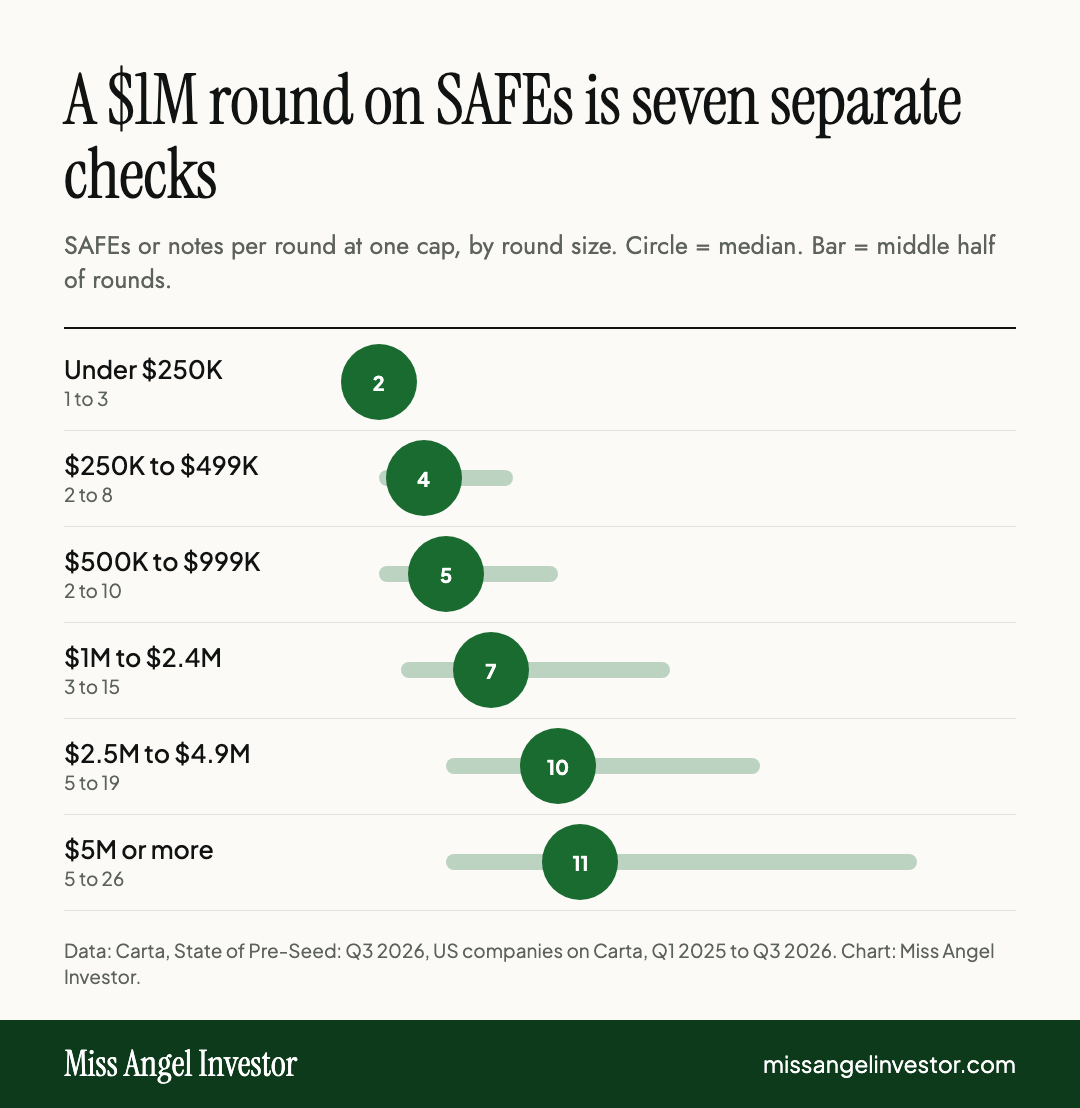
A raise of $1M to $2.4M on SAFEs is seven separate checks at the median, in Carta's State of Pre-Seed: Q3 2026.
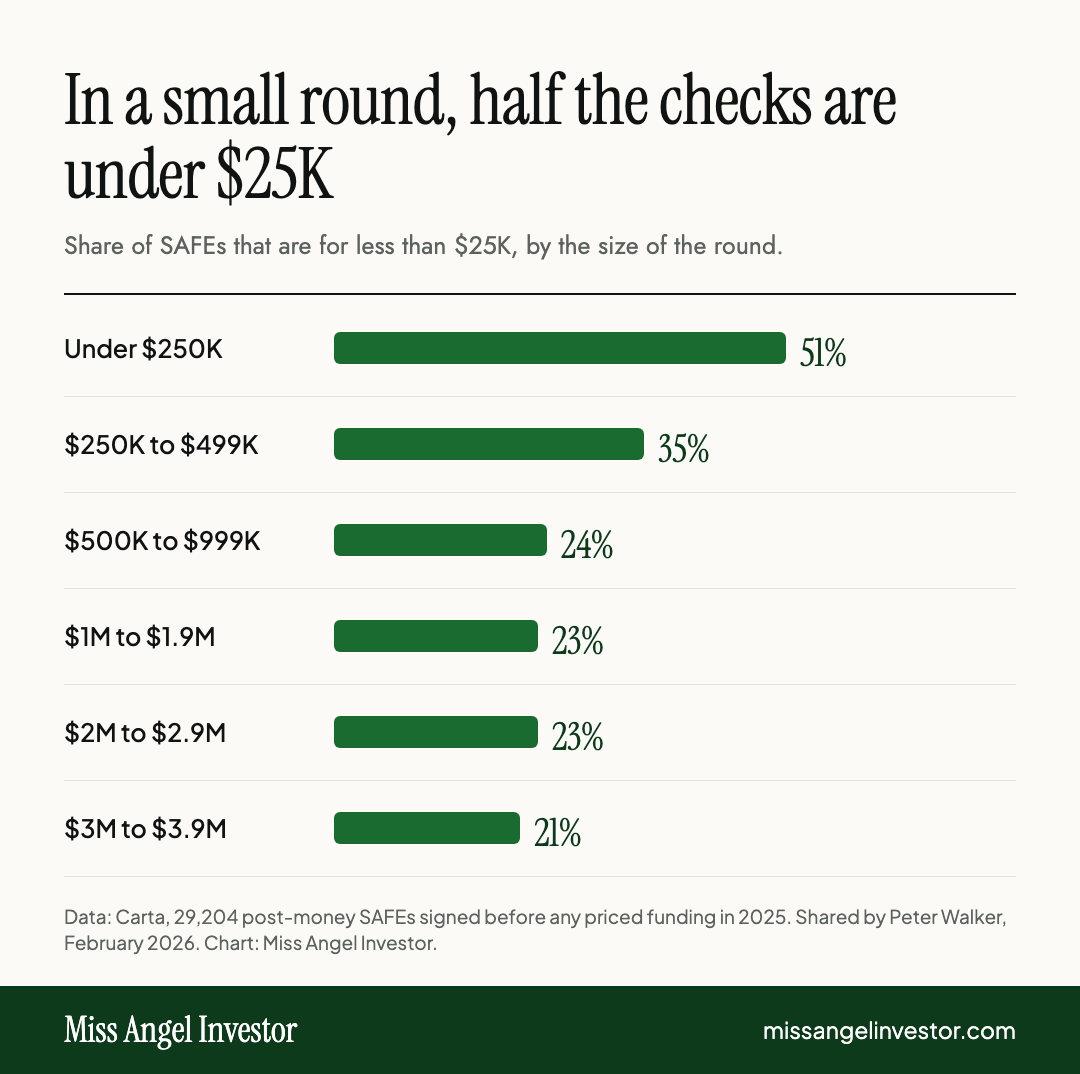
Small checks are normal. In rounds under $250K, about half of the SAFEs are for less than $25K, in Carta data on 29,204 SAFEs signed in 2025.
04Try it with AI
Copy this prompt into Claude or ChatGPT, fill in the brackets and run it on your own company.
Here is my investor CRM export: [paste]. Group investors by stage, flag everyone I haven't followed up with in 7 days, draft a short follow-up for each using the last thing we discussed, and tell me which stage of my funnel is losing the most investors.
Data: Carta data shared by Peter Walker, When are VC deals signed?, 2025-03-18. Primary rounds signed by US startups on Carta, 2018 to 2024.
Educational content, not legal, tax or financial advice.
Want help applying this to your company? Yearly 1:1 coaching, by application.
Work with me →