 Angie Carrillo
Are you VC-backable? The honest checklist
A fund can pass on a good business because of its own return math. Here is the math, and two lists to place your company.
01The question on every founder's mind
Why do investors pass on a business that is clearly working?
02My position
A fund will pass on a good business that cannot return the fund.
I see a lot of companies that are not venture-backable. Ask the question an investor asks: why would they fund you if they can fund your competitor?
A VC-backable business is one that can become a unicorn, with hypergrowth potential. If you don't want to grow that fast, or your region's market is too small and you aren't planning to expand to the US, venture isn't your path, and that's fine.
On the selection side at Draper University I saw strong founders lose a year pitching funds that were never built to back their model.
Carta data shared by Peter Walker shows why the funds are built that way. It covers 400+ US venture funds from the 2016, 2017 and 2018 vintages. The metric is net TVPI: the total value of a fund's holdings plus what it has already paid out, divided by the money its investors put in, after fees. Walker notes these funds may still grow a bit, and the distribution is unlikely to shift much.
| Fund percentile | Net TVPI |
|---|---|
| 25th | 1.06x |
| 50th | 1.38x |
| 75th | 2.09x |
| 90th | 3.37x |
| 95th | 4.72x |
| 99th | 13.12x |
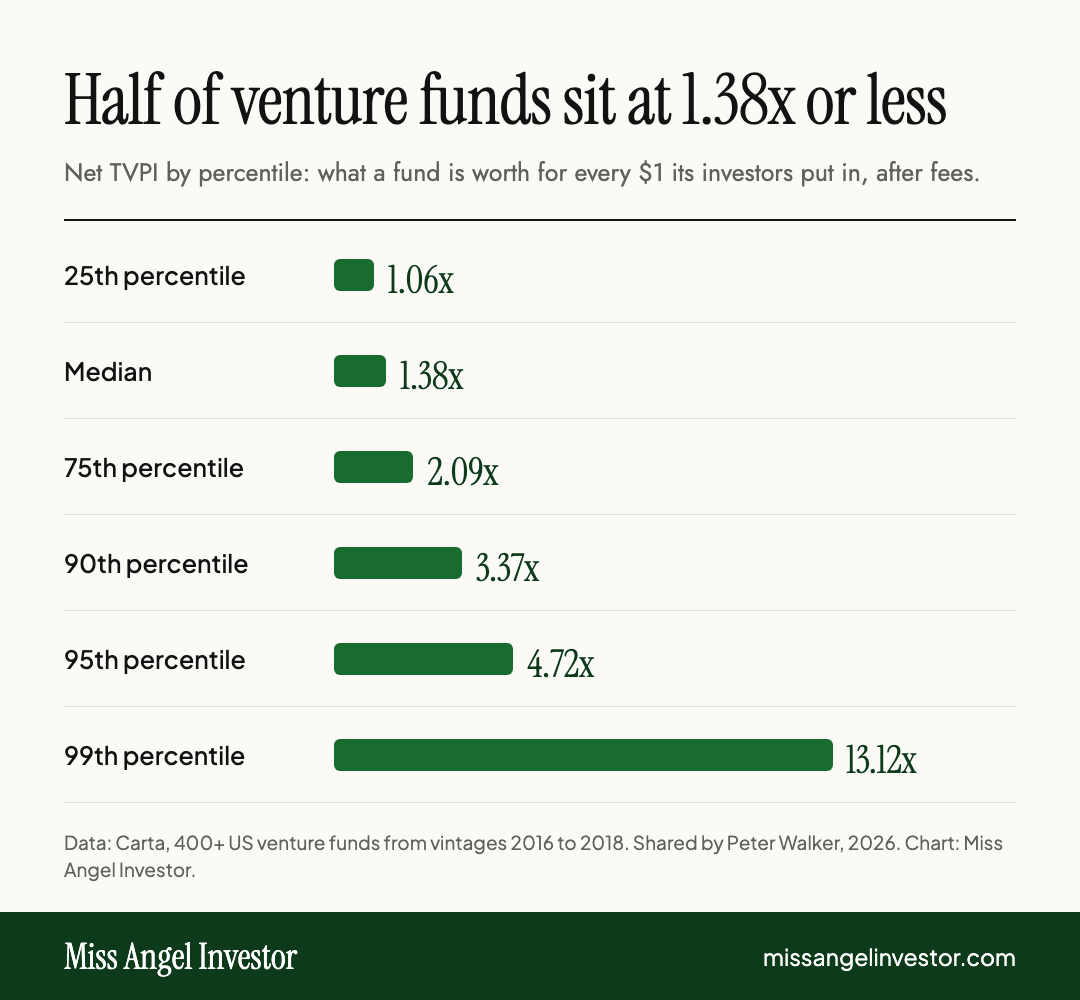
The middle fund returned $1.38 for every $1 its investors put in, after roughly 8 to 10 years. Only the top few funds returned several times their money.
That is the pressure behind every partner meeting. A fund needs a few companies that return many times the whole fund, so the partner asks one question about you: can this company become very large? A healthy business that cannot gets a pass, and the pass says nothing about your work.
A pass on a company with real revenue can mean many things. Your company may compete with one the fund already backed. And when an investor has a doubt, no is the safer answer than yes.
03How this works
The size of the fund you pitch sets how big your exit must be.
Venture money also concentrates. Carta's State of Pre-Seed: Q3 2026, by Hamza Shad, reports that California took 64% of US pre-seed cash in Q3 2026, with much of it going to AI startups in California. If you are outside California and outside AI, expect a smaller pool of pre-seed money and plan your raise around that.
The math, with made-up numbers
These numbers are invented to show the arithmetic. Say a $50M fund owns 10% of your company when it is sold.
For your company alone to return the whole fund, it must sell for $500M. Ten percent of $500M is $50M.
Now a $500M fund with the same 10%. Your company must sell for $5B.
Now say the fund bought that 10% with its first check, and later rounds dilute it to 5% by the time you sell. The $50M fund now needs a $1B sale. The $500M fund needs $10B.
And returning the fund once only gets investors back to 1x, before fees. The median fund in this data reached 1.38x, which on $50M is $69M. That is why a fund needs a few companies that return many times the whole fund.
Run this on your own company before you book a single pitch.
You're VC-backable if
- You can picture an exit many times the size of the fund you are pitching.
- You're going after a market worth billions.
- Your growth can compound fast.
- You have a technology or distribution edge others can't copy quickly.
- You're willing to grow at venture speed.
- Your vision is a global company, beyond a profitable one.
You're probably on the other list if
- Your model is sustainable, profitable and grows at a moderate pace.
- A good exit for you is a sale well below what a fund needs to return itself.
- You want full control.
- You don't want to operate under extreme pressure.
- Your business can't scale exponentially.
Count your checks
Four or more on the first list means venture is worth exploring. Four or more on the second means monetize first and raise later, from strength.
Landing on the second list says nothing about the quality of your company or of you as a founder. It tells you which kind of capital fits. Plenty of founders build wealth, freedom and great companies on that list, and they keep far more of what they built.
The numbers behind this
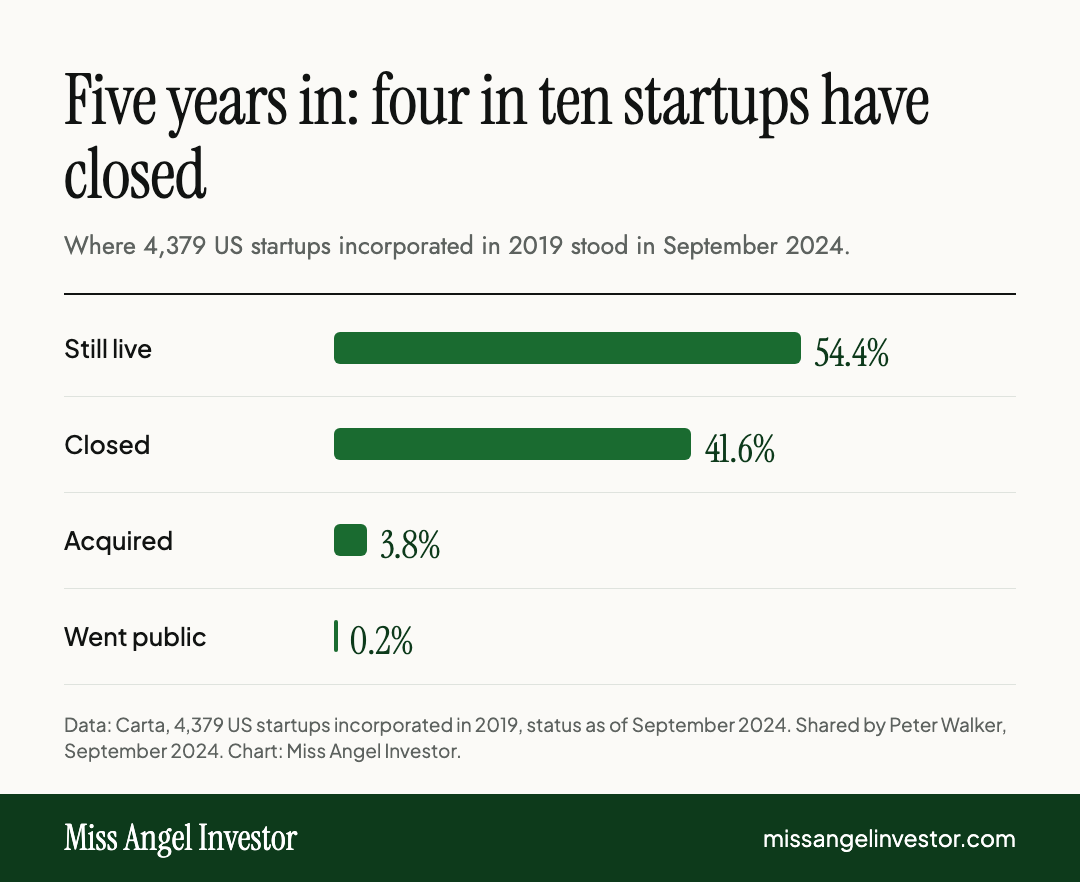
Carta tracked 4,379 US startups incorporated in 2019. Five years later, 54.4% were still live, 41.6% had closed, 3.8% had been acquired and 0.2% had gone public.
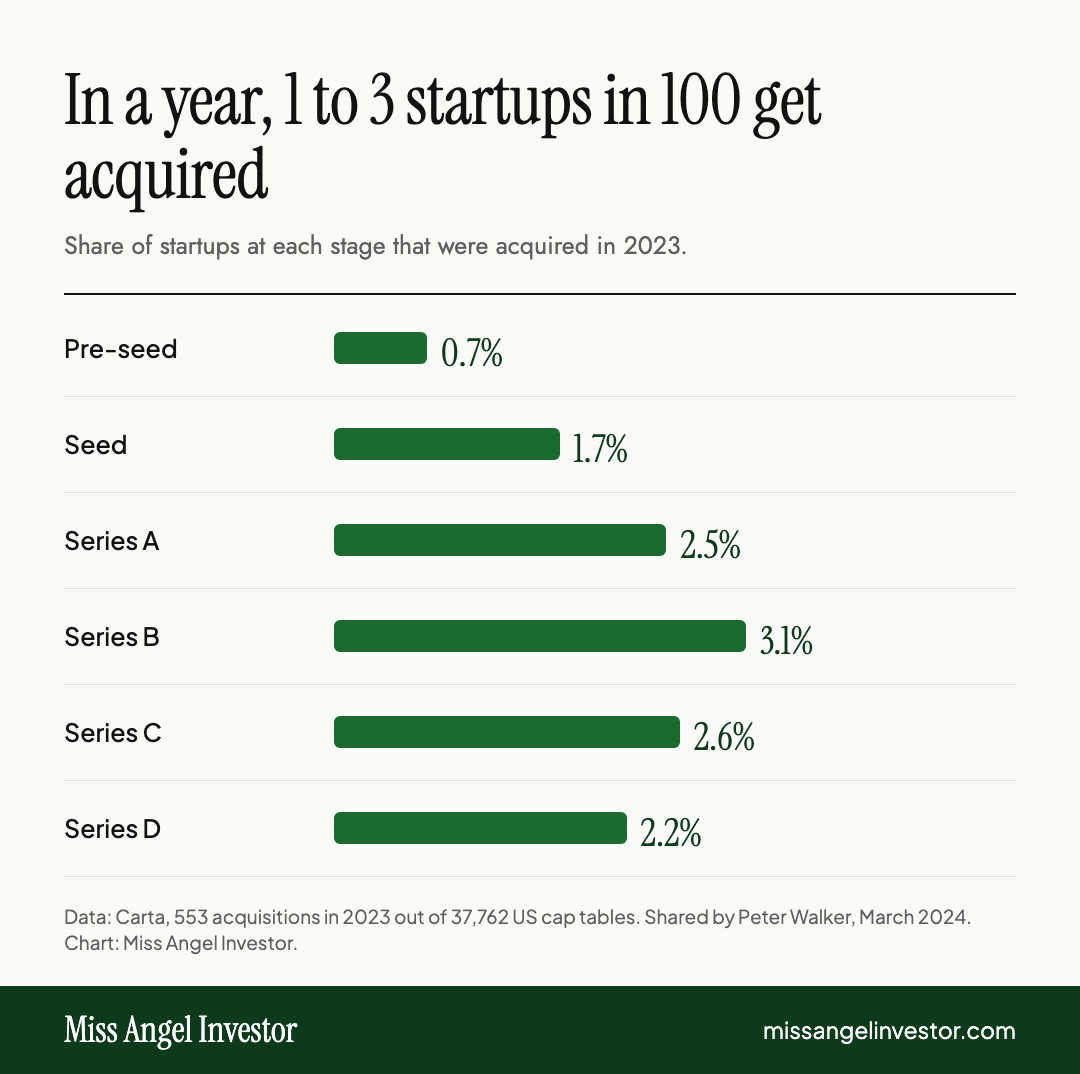
In 2023, between 0.7% and 3.1% of startups on Carta were acquired, depending on the stage.
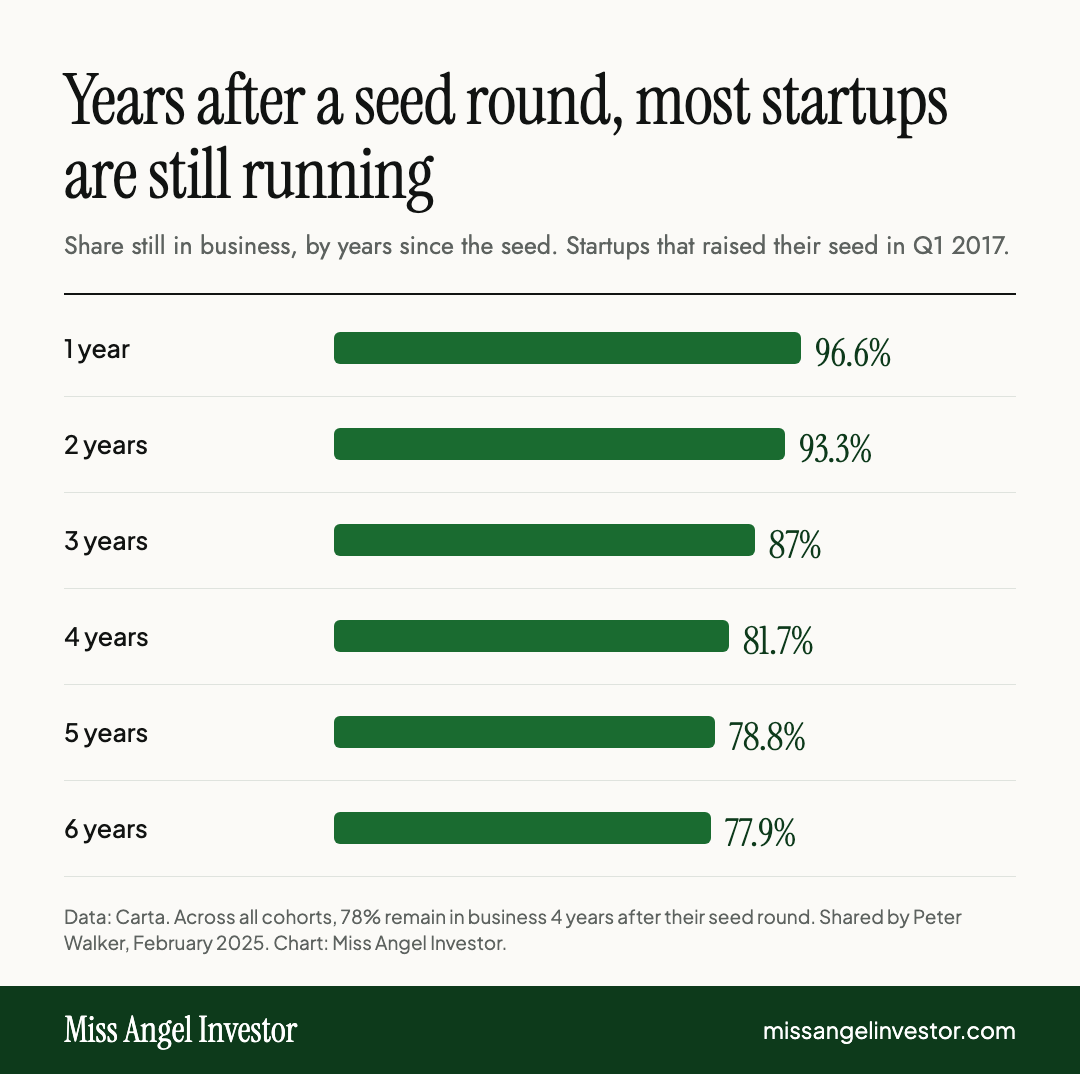
Startups that raise a seed keep going for years. Across Carta's cohorts, 78% are still in business four years after their seed round.
04Try it with AI
Copy this prompt into Claude or ChatGPT, fill in the brackets and run it on your own company.
Act as a seed-stage VC partner with a $50M fund. Here is my company in one paragraph: [paragraph]. Tell me whether this can return the fund on its own, what a realistic exit size is, and which kind of capital fits it best if venture doesn't.
Data: Carta data shared by Peter Walker, 400+ US venture funds, 2016 to 2018 vintages, net TVPI. Carta, State of Pre-Seed: Q3 2026, by Hamza Shad.
Educational content, not legal, tax or financial advice.
Want help applying this to your company? Yearly 1:1 coaching, by application.
Work with me →Funding without VC: bootstrapping, angels and revenue-based financing
Venture capital is one road. Here are the others, what each one costs you and when each one fits.
Raise moneyHow much to raise: an ask investors say yes to
Tie your ask to the next milestone, then check it against the caps that rounds of that size are getting right now.