 Angie Carrillo
Funding without VC: bootstrapping, angels and revenue-based financing
Venture capital is one road. Here are the others, what each one costs you and when each one fits.
01The question on every founder's mind
If venture capital doesn't fit, how else do I fund my company?
02My position
Most great companies are funded by something other than a venture fund. Choosing the capital that fits your model protects your equity and your sanity.
When a founder tells me they don't want VC money, my reaction is: this is interesting, tell me more.
When I teach the "raise or not raise" class, this is the part that makes founders exhale. You have more options than a venture fund, and each one has a cost that is easy to miss.
Bootstrapping costs time and personal risk. Angels cost you equity, and too many small checks crowd your cap table. Revenue-based financing takes a slice of every month's sales, which hurts when margins are thin. Pick the cost you can live with.
The mistake I see most with SAFEs is founders who stop managing their math. They end up diluted more than 20% before a priced round.
Carta's State of Pre-Seed: Q3 2026 puts numbers on it. For US companies on Carta whose latest SAFE round was $1M to $2.4M, the median expected dilution from post-money SAFEs is 16.7%, and one founder in four is past 25.2%.
03How this works
Bootstrapping
You grow with your own revenue and keep all of the company. It fits service businesses and models with positive cash flow early. The cost is speed and personal risk, because growth waits for your cash and your own money covers the bad months.
Peter Walker, who led insights at Carta, wrote a LinkedIn post on November 28, 2025 about a bootstrapped company with a clear path to profit. His view is that many times a founder in that spot should skip venture. He gives three reasons some take it anyway: cash to grow faster, a well-known fund that helps you hire, and an investor's network for introductions. If you can grow at the speed you want on your own revenue, keep building.
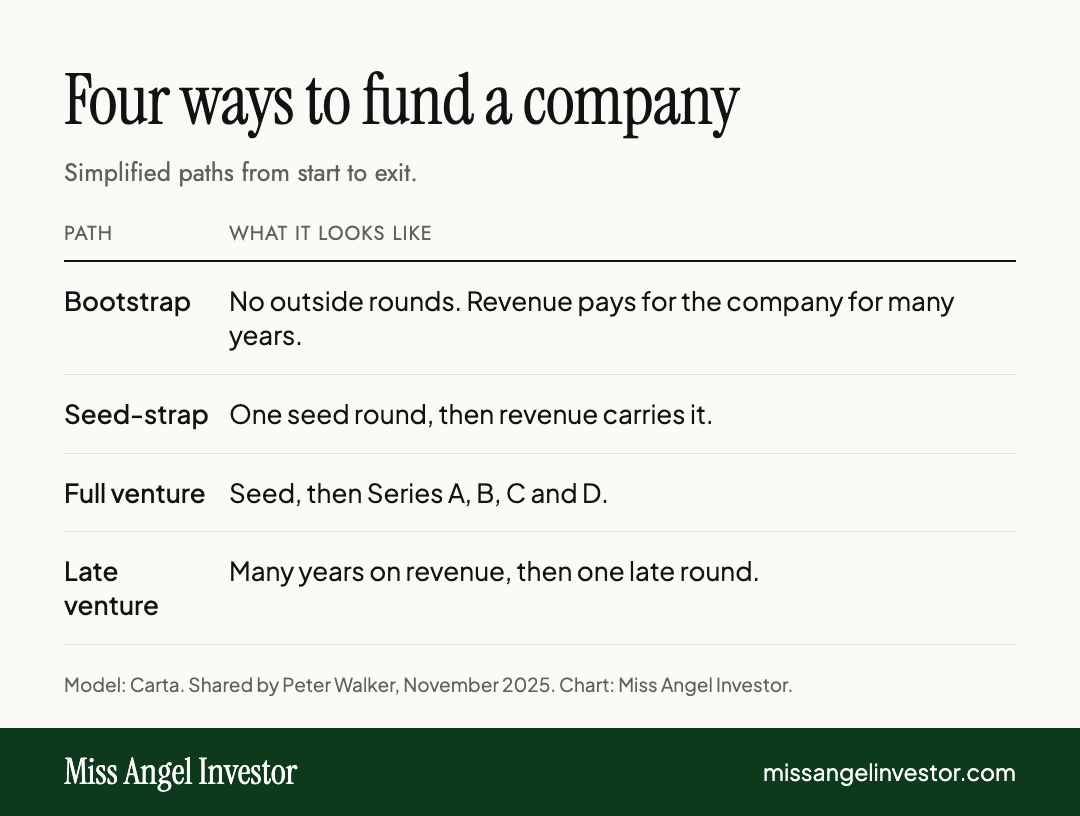
One of my angel investments was already making money and raised to go faster and be first in its category. That is the kind of ask that makes me lean in.
Angel investors
Angels fit pre-seed. They decide fast, accept flexible terms and often bring hands-on mentorship. You still give up equity, usually through a SAFE. In Q3 2026, 94% of pre-seed rounds on Carta used SAFEs and 6% used convertible notes.
The cost is your cap table. Carta counts a round as all the SAFEs or notes raised at the same valuation cap. This is what rounds look like for US companies on Carta.
| Round size, at one cap | Median SAFEs or notes per round | Expected dilution, 25th / 50th / 75th percentile |
|---|---|---|
| $500K to $999K | 5 | 5.3% / 10.2% / 17.4% |
| $1M to $2.4M | 7 | 11.0% / 16.7% / 25.2% |
| $2.5M to $4.9M | 10 | 13.3% / 20.2% / 27.5% |
Raise in steps. The asks I trust are tied to milestones: I need this money to get to this milestone, then this amount to get to the next one.
Some industries lean on convertible notes more. This is the share of pre-seed dollars raised on notes, Q1 2025 to Q3 2026.
| Industry | Share of pre-seed dollars on notes |
|---|---|
| Biotech and pharma | 31% |
| Medical devices | 23% |
| Energy | 19% |
| Consumer | 18% |
| Healthtech | 16% |
| Hardware | about 9% |
| SaaS | about 8% |
If you bridge after a Series A
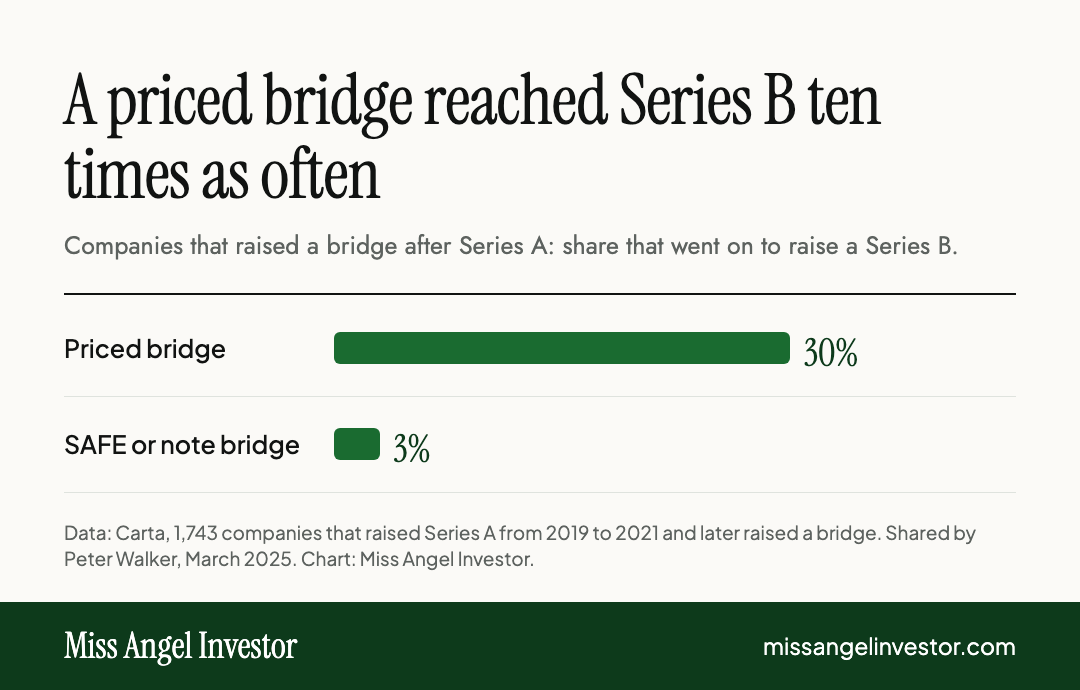
Carta looked at 1,743 companies that raised a Series A from 2019 to 2021 and have since raised an extension. Of the 1,082 that used a priced extension, 30% went on to raise a Series B. Of the 661 that used a SAFE or convertible note, 3% did.
These are Series A companies, a later stage than a typical angel round. Walker offers possible reasons and labels them speculation, so read the 3% as a pattern with no proven cause. Ask your lawyer which instrument fits an extension, and ask your investors why they prefer it.
Revenue-based financing
You get capital now and repay it as a percentage of your monthly revenue until you have paid back an agreed multiple. You keep your equity. It needs a revenue history, so it fits e-commerce and SaaS businesses with steady sales.
The cost is a slice of every month's sales. Repayment follows your revenue, so thin margins make that slice hurt.
The quick match
- Cash flow positive early: bootstrap.
- Pre-seed with a strong team and an early product: angels.
- Steady revenue and you want to keep your equity: revenue-based financing.
You can combine them. Many founders bootstrap to revenue, bring in a few angels for speed, and talk to funds once the numbers make the round easy.
The math, with made-up numbers
Say you need $60,000 for inventory. Your revenue is $50,000 a month at a 30% gross margin, so you keep $15,000 of gross profit a month.
With revenue-based financing the agreed multiple is 1.2, so you repay $72,000. At 8% of revenue that is $4,000 a month for 18 months, or 26.7% of your gross profit. If your margin drops to 20%, gross profit is $10,000 and the same $4,000 takes 40%.
With angels you raise the same $60,000 on a $6M post-money cap, which is 1% of the company. Divide the $72,000 by that 1% and you get $7.2M. If your company ends up worth less than $7.2M, the angel money cost you less than repaying. Above $7.2M, it cost you more. This leaves out later rounds, which shrink the angel's 1%, and a SAFE that converts below its cap, which gives the angel more than 1%.
04Try it with AI
Copy this prompt into Claude or ChatGPT, fill in the brackets and run it on your own company.
Here are my monthly revenue, margins and growth plan: [paste]. Compare bootstrapping, angel investment and revenue-based financing for my business. For each one, estimate what it costs me in equity or cash over 24 months and which fits best.
Data: Carta, State of Pre-Seed: Q3 2026, by Hamza Shad, US companies on Carta. Carta data shared by Peter Walker: bridge round post, March 11, 2025 and bootstrapping post, November 28, 2025.
Educational content, not legal, tax or financial advice.
Want help applying this to your company? Yearly 1:1 coaching, by application.
Work with me →How much to raise: an ask investors say yes to
Tie your ask to the next milestone, then check it against the caps that rounds of that size are getting right now.
Raise moneyThe 6 numbers investors ask for: burn, runway, CAC, LTV, payback, margin
Know these six numbers cold before your first meeting. They are how investors check whether your story holds.