 Angie Carrillo
Make money, raise money or invest money
3 ways to fund your company
01The question on every founder's mind
Should I raise money, focus on sales, or put my own money in?
02My position
Every company gets paid for by someone: your customers, your investors or you, and the founders who choose on purpose keep more of what they build.
Everyone starting a business asks this. I ask it myself while I build a new company. If part of you needs the validation, or you want the experience of raising, then raise. Otherwise focus on sales. Sales give you insight from customers much faster, and being sales-driven beats living on your own money.
Now that I've sat on every side of this decision, my answer is simple: before you raise money, have traction that proves people want what you're building. I've been an angel investor since 2018, reviewed 100+ founders on the selection side at Draper University, designed Fundraising School, and today I'm building Timefull.
The pattern I see most is founders raising by default, because everyone around them is raising. The path I see least is the third one. Every founder puts some of their own money in to get the company started, because there are always expenses. Most never quantify it. That same money can go in as an angel investment in yourself, on the same terms as your investors.
Founders hear about dilution all the time. Almost nobody talks to them about seniority. In a modest sale, investors with preferred stock get their money back first, and the common stock founders hold can end up with little or nothing. How much you own matters, and so does where you stand in line.
A 2025 NBER study of US venture-backed companies found that even among those that reached an IPO or acquisition, 24% left their founders with nothing.
03How this works
Path 1: Make money
Your customers pay for the company. You keep your equity and you answer to no board. Pick it when you can bring in cash in the first six months. More in the 6-month revenue rule.
More founders now start alone. Carta data shared by Peter Walker shows that 18% of companies that joined Carta in 2016 were run by solo founders, and 36% in 2025. The data covers companies on Carta only.
Path 2: Raise money
Investors pay for the company. Capital buys speed, in exchange for equity and preferred stock that gets paid back before yours. Pick it when you're building in a market big enough for venture returns, you know the rules investors play by, and you can raise from the best. More in should you raise.
The price shows up in ownership. The same Carta data gives the median founding team ownership the day after each round closes, from 3,500+ US startups, no deep tech:
| Round | Founding team owns |
|---|---|
| Priced seed | 55.1% |
| Series A | 36.6% |
| Series B | 23.5% |
| Series C | 17.5% |
| Series D | 10.9% |
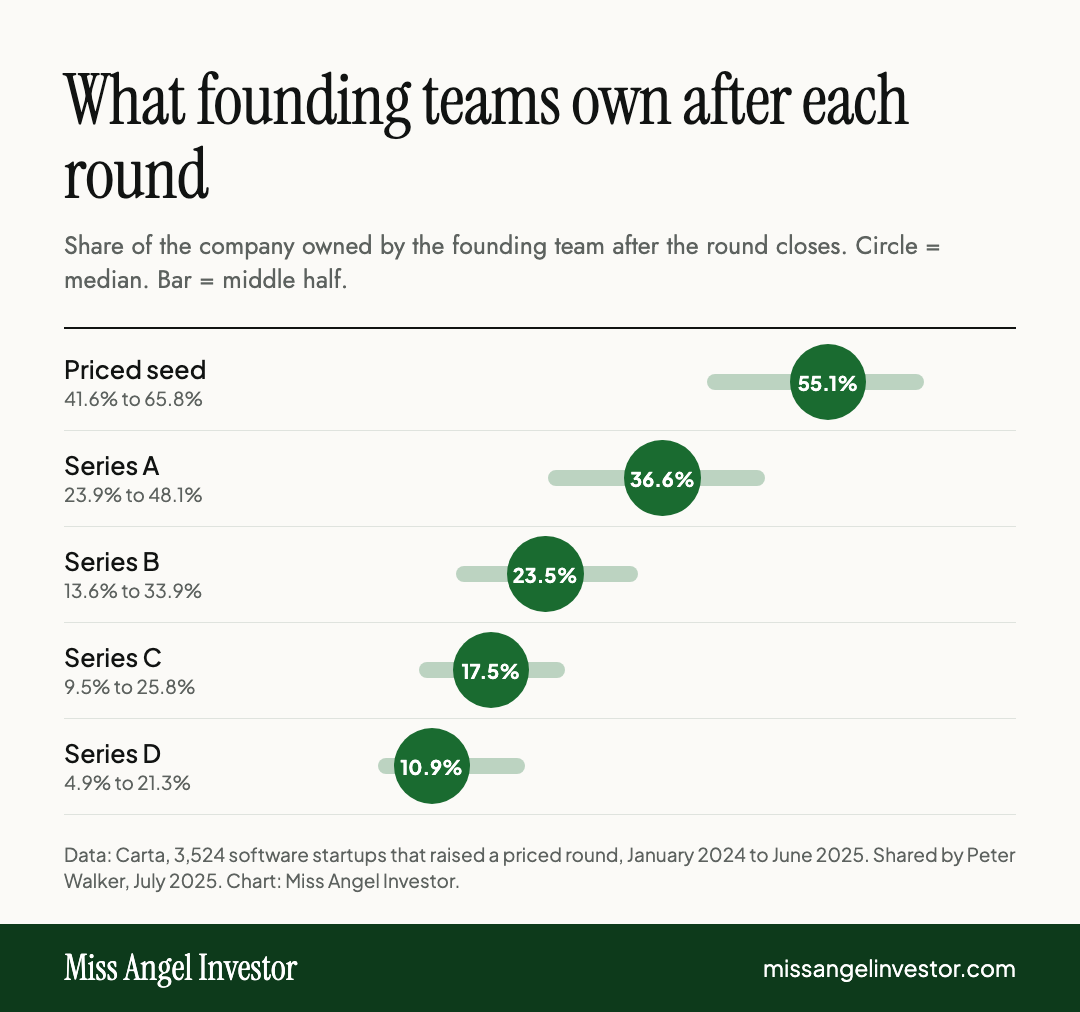
Carta's round benchmarking shows the median share sold at seed is 20% or more in every sector it lists. SaaS is 20.1% and consumer is 20.0%. Those are medians for priced rounds from Q3 2021 to Q3 2026.
Path 3: Invest money
You pay for part of the company, on investor terms. Founders usually hold only common stock, which is last in line when a company sells. When you put your own cash in on the same terms as your outside investors, that money buys the same preferred stock they hold. More in invest in your own company.
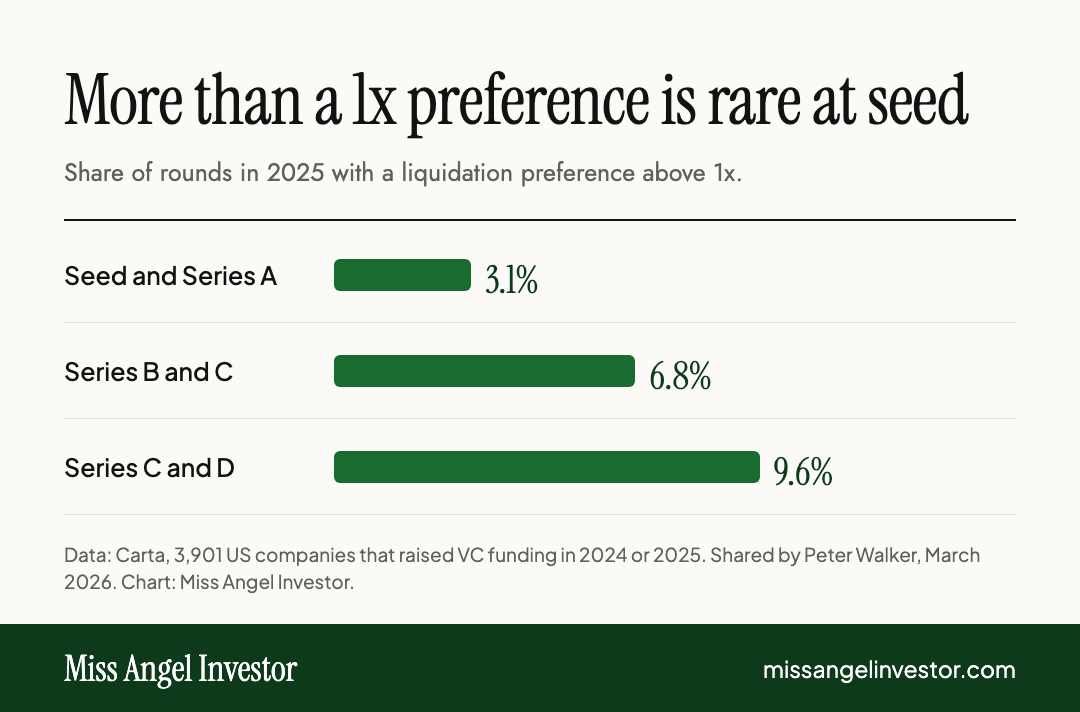
Preferred stock gets its money back before common. Carta's data shows only 3% of seed and Series A deals in 2025 had a liquidation preference above 1x. A 1x preference means the money you put in comes back first at exit, before common gets anything.
The rule
- Revenue in six months: make money.
- A venture-scale market: raise money, from the best.
- Cash you can afford to lose and conviction: invest money alongside your investors, on their terms.
The paths combine
Many strong companies make money first, raise later from strength, and have founders who invest in their own rounds so part of their stake sits in preferred stock.
One of my angel investments was already making money when it raised. It raised to go faster and be first in its category.
The math, with made-up numbers
These numbers are invented. Say you plan to spend $500K, and you can fund it three ways.
- Customers. You keep 100%. It takes as long as your sales take.
- Investors. At a $10M post-money valuation you sell 5% now, and every later round sells more.
- You put in part of it. Say $100K is yours and $400K comes from investors at the same $10M post-money valuation, in a priced round. Your investors hold 4% and your $100K holds 1%. That 1% sits in the same preferred stock as theirs, and it gets paid back before the common stock you hold as a founder.
Put your own numbers in each path before you pick one.
04Try it with AI
Copy this prompt into Claude or ChatGPT, fill in the brackets and run it on your own company.
Here is my company in one paragraph: [paragraph]. Here is my situation: monthly revenue [$], cash I could personally afford to lose [$], and when I want to raise [date]. Tell me which of the three paths fits right now, make money, raise money or invest money, how to combine them over the next 24 months, and what would have to be true to switch paths.
Data: Carta data shared by Peter Walker on solo founders, February 2026, founder ownership by round, July 2025 and liquidation preferences, March 2026. Carta round benchmarking. NBER, 2025 study.
Educational content, not legal, tax or financial advice.
Want help applying this to your company? Yearly 1:1 coaching, by application.
Work with me →The 6-month revenue rule
If your business can bring in cash in the first six months, sell before you raise. Half of US tech companies that raised a seed in 2024 to 2025 had $0.22M in revenue or less.
Invest moneyInvest in your own company: why founders should become angels
Common stock is last in line in a sale. How founders, and their families, can invest on the same terms as investors, and the rules that keep it clean.