 Angie Carrillo
Should you raise? 7 reasons yes, 7 reasons no
Venture capital is one vehicle among several. Here are the reasons to take it, the reasons to walk away, and what a yes costs you in ownership.
01The question on every founder's mind
Should I raise venture capital at all?
02My position
Raising capital is a choice, and the best founders make it on purpose.
If you can afford not to raise, don't. When I designed the first class of Fundraising School, it opened with this question, because the founders who skip it tend to raise by default and regret the terms later. The goal is clarity, so you neither romanticize venture capital nor demonize it.
Once you take venture money, the decision is hard to reverse. Your investors need an outcome big enough to matter to their fund, and that expectation shapes every choice after the wire lands: how fast you hire, which markets you enter, when you sell. Founders who raise for the right reasons rarely regret it.
I came to Silicon Valley to raise for my company in Mexico. I asked for a million pesos, about $50K, and investors told me I needed to understand how venture works. That lesson starts with what each round costs you.
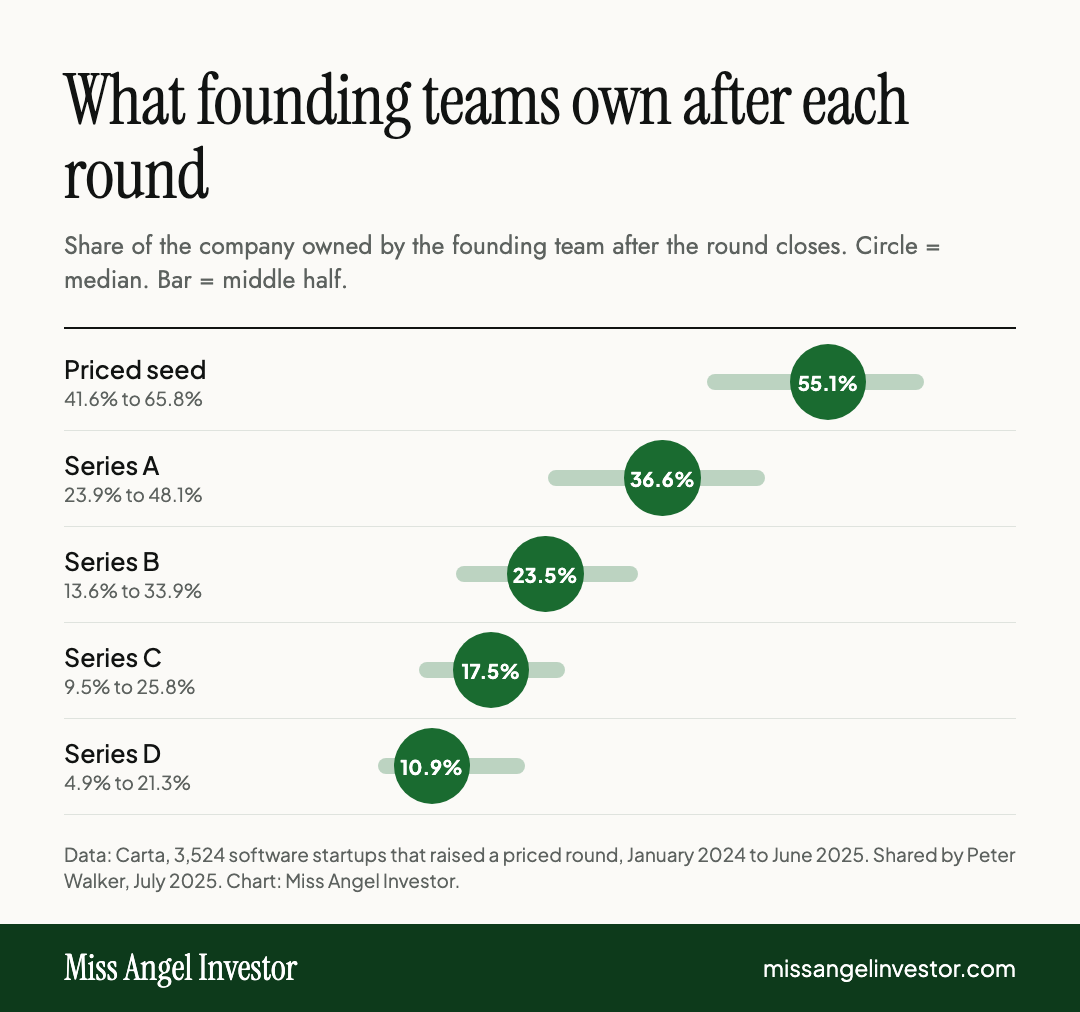
Carta data shared by Peter Walker covers 3,524 software startups that raised a priced venture round from January 2024 to June 2025. The median founding team owns 55.1% after seed, 36.6% after Series A and 23.5% after Series B. Peter Walker's post from July 2025 adds that only 1 in 5 founding teams at VC-backed startups own 50% or more after a Series A.
A lot of founders are choosing not to raise. When you raise, you get another boss: someone to update, someone to keep happy, and someone who gives you unsolicited advice because they gave you money. If you want control of your company, better not to raise.
03How this works
7 reasons to raise
- You want hyper-growth badly enough. A giant market plus aggressive execution needs fuel to capture share.
- Your team can execute. A track record of making things happen and a mature relationship with pressure.
- Your market is winner-takes-all. Network effects and switching costs make the number two player worth a fraction of the leader.
- Your economics need it. When a customer pays back what it cost to win, capital runs that cycle faster.
- Capital buys scale and defense. More channels and cities, plus moats in data, integrations and community.
- Your competitors are raising. If they accelerate and you don't, you fall structurally behind.
- The investor brings more than money. Customers, talent, operating know-how and discipline.
7 reasons not to raise
- You want quality over speed. Growing too fast can break your customer experience and your team.
- You can grow fast without it. High margins and quick payback let customers fund your growth.
- You want early liquidity. Peter Walker notes a fund usually runs 10 years, and its investors may wait 15 years from the fund's start to get all their money back.
- You need a lot of control. Venture money means a partner with a vote and formal reporting.
- You don't want fiduciary duties. You become responsible for returns to someone else's investors.
- You want to build several businesses. Venture wants extreme focus on one.
- Your model isn't built for venture returns, and you like it that way. A profitable business in a smaller market is still a great business.
Score yourself
Count both lists. If the "no" list wins, read funding without VC. If the "yes" list wins, read are you VC-backable.
The price of yes
Founding team ownership after each round, Carta data shared by Peter Walker, 3,524 startups, January 2024 to June 2025:
| Round | Median | Middle half of founding teams |
|---|---|---|
| Seed | 55.1% | 41.6% to 65.8% |
| Series A | 36.6% | 23.9% to 48.1% |
| Series B | 23.5% | 13.6% to 33.9% |
| Series C | 17.5% | 9.5% to 25.8% |
| Series D | 10.9% | 4.9% to 21.3% |
Peter Walker puts the usual slice sold at about 20% in the seed round, 20% in the A and 15% in the B, and says that pattern has held for several years.
The price in time and odds
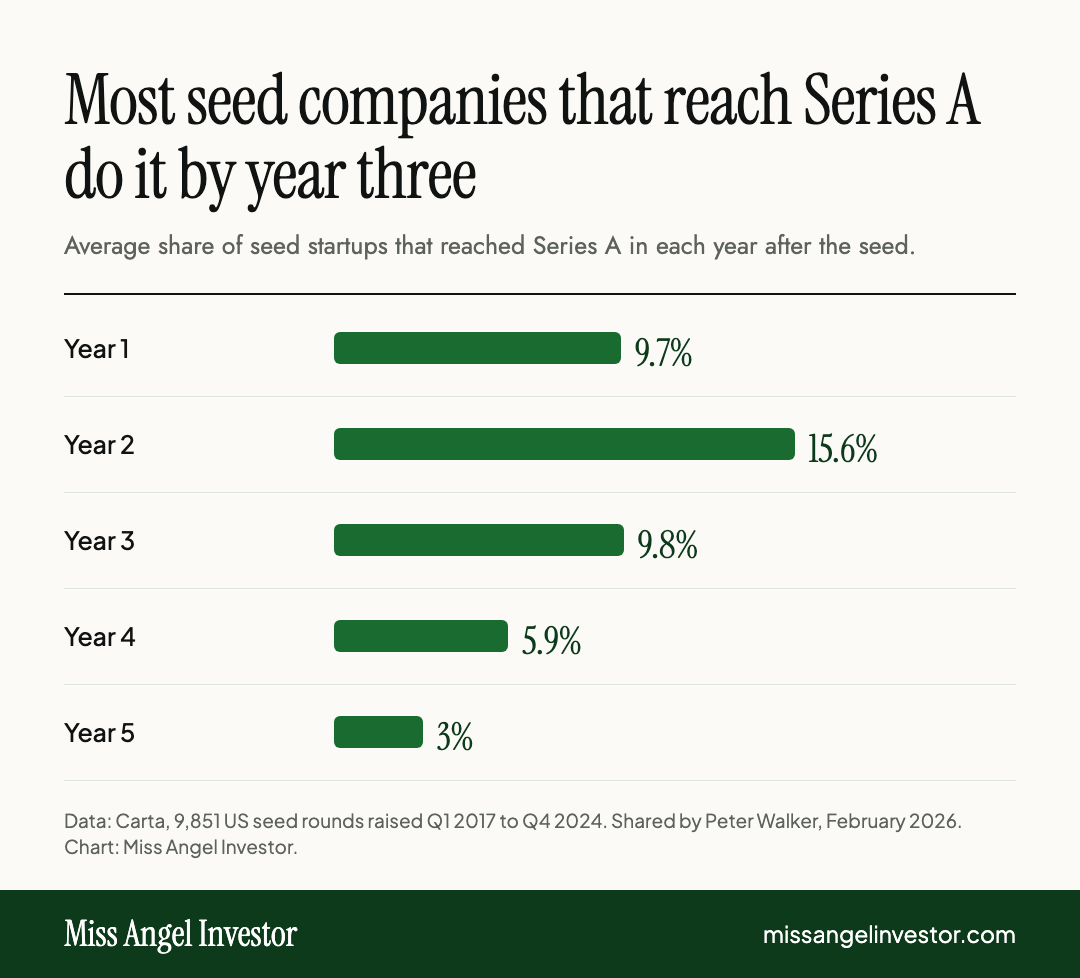
In February 2026 Peter Walker shared Carta data on 9,851 US seed rounds raised from Q1 2017 to Q4 2024. This is the average share of seed startups that graduated to Series A in each year after the seed round.
| Year after seed | Reached Series A |
|---|---|
| Year 1 | 9.7% |
| Year 2 | 15.6% |
| Year 3 | 9.8% |
| Year 4 | 5.9% |
| Year 5 | 3.0% |
By the end of Year 3, 80% of the startups that will ever graduate have done so.
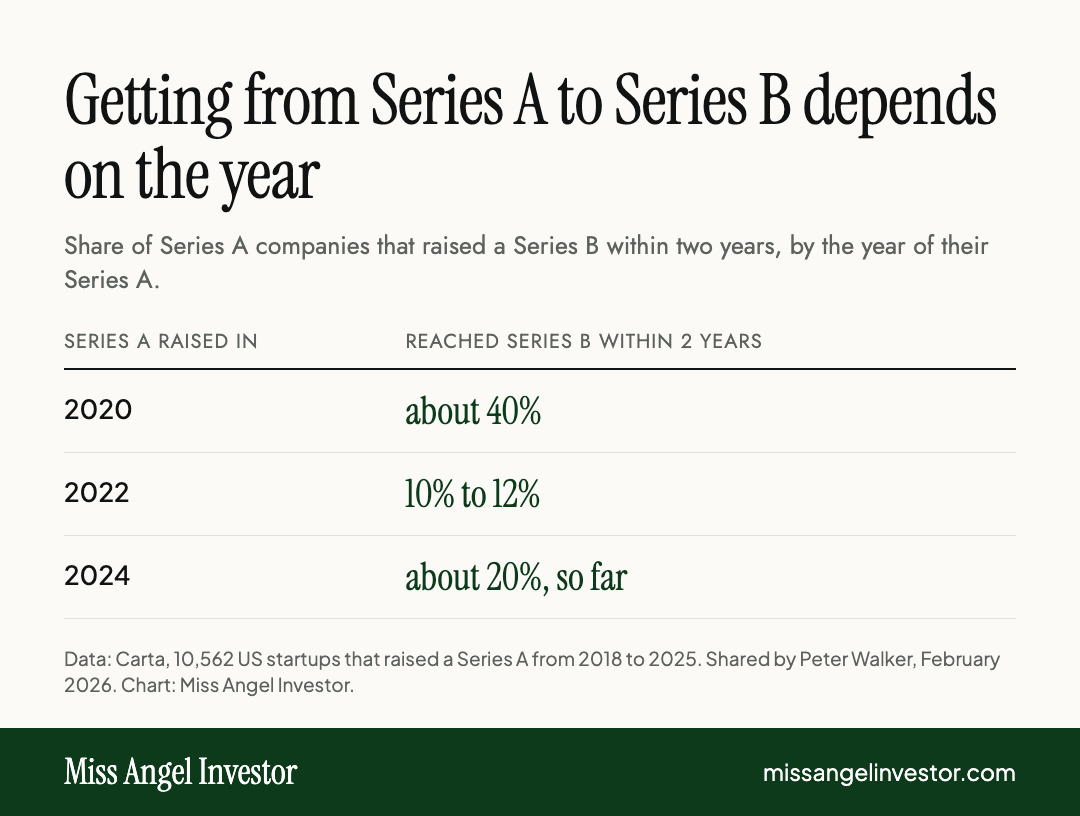
Then the Series B. In February 2026 he shared Carta data on 10,562 US startups that raised a Series A from 2018 to 2025. He says the year you raise your A matters a great deal, because the odds of reaching a B swing with the market, and you can't control the market.
| Series A raised in | Got to Series B within 2 years |
|---|---|
| 2020 | about 40% |
| 2022 | 10% to 12% |
| 2024 | looking like about 20% |
In a good year, he puts the share that reach a B at about half. Most of the others, in his read, keep going for a while and then close.
Three reasons a profitable founder still raises
Peter Walker writes that for a bootstrapped company with a clear path to profit, the answer is often to skip VC. He gives three reasons founders in that spot raise anyway, here in my words.
- Faster growth. If more cash could compress a year of growth into six months, trading equity for it can pay, because growth drives valuation and sale price.
- Hiring pull. A well-known fund helps you win the next strong engineer, and some investors recruit for you personally.
- Introductions. A good investor can reach the contact at a major prospect, the technical expert or the founder who solved your problem.
If none of the three applies to you, his advice is to keep building on your own money.
The math, with made-up numbers
Say you run a profitable company and own all of it. A buyer would pay $10M today.
You raise, and by Series B you sit at the median, 23.5%. To take home the same $10M you need a sale at $42.6M, because $10M divided by 0.235 is $42.6M. At the median after Series A, 36.6%, the number is $27.3M.
Now add what the money buys. Say the raise gets you a year of growth in six months and the company sells for $60M. Your 23.5% is $14.1M. Sold for $35M, it is $8.2M, less than you hold today.
So the question has a number in it. Can the capital move your company past the breakeven sale, and can it do it inside the years the tables above show?
04Try it with AI
Copy this prompt into Claude or ChatGPT, fill in the brackets and run it on your own company.
Here are my answers to the 7 reasons to raise and the 7 reasons not to raise: [paste your notes]. Act as a neutral advisor. Tell me which list is winning, which of my answers sound like wishful thinking, and what I should prove in the next 90 days before deciding.
Data: Carta data shared by Peter Walker on LinkedIn, posts of 2025-07-11, 2025-11-28, 2026-02-13 and 2026-02-25.
Educational content, not legal, tax or financial advice.
Want help applying this to your company? Yearly 1:1 coaching, by application.
Work with me →Are you VC-backable? The honest checklist
A fund can pass on a good business because of its own return math. Here is the math, and two lists to place your company.
Make moneyFunding without VC: bootstrapping, angels and revenue-based financing
Venture capital is one road. Here are the others, what each one costs you and when each one fits.