 Angie Carrillo
The fundraising glossary.
77 terms investors use, grouped by when you will need them, with the analogies I use to explain them. Educational only, not legal, tax or financial advice. I am not a lawyer.
- SAFE (Simple Agreement for Future Equity)
An investment instrument that lets someone invest without setting a valuation today. It converts into shares in a future round. If it includes a valuation cap, it protects the investor with a maximum valuation. If it is uncapped, the conversion uses the future valuation, sometimes with a discount. Signing a SAFE is like a promise ring, where you haven't gotten married or actually committed to an engagement ring.
Read: SAFEs explained: caps, discounts and what you really give up →- Term sheet
A non-binding document that sets the key conditions of the investment: valuation, amount and terms. It is the starting point of the formal negotiation. A term sheet, before signing it, should be reviewed by your lawyer. That is a really important document.
Read: Negotiation and closing: the term sheet terms that matter →- Pre-money valuation
The value of the company right before it receives capital.
- Post-money valuation
The value after the investment: pre-money plus the investment.
Read: SAFEs explained: caps, discounts and what you really give up →- Valuation cap
On a SAFE, the maximum valuation at which the investor's money converts into shares.
Read: SAFEs explained: caps, discounts and what you really give up →- Priced round
A round where investors buy shares at a set price per share, with a valuation agreed upfront. SAFEs convert into shares at this round.
Read: SAFEs explained: caps, discounts and what you really give up →- Cap table (capitalization table)
A detailed record of the ownership structure, showing who owns what percentage. You need it to see your dilution.
Read: SAFEs explained: caps, discounts and what you really give up →- Dilution
The drop in your ownership percentage when the company issues new shares to investors or employees. Think of a cake. Cakes for weddings are overpriced and bigger. A normal cake you make at your house is the ownership of a normal business. A fancy store-bought birthday cake is a piece of a company that is raising capital. A wedding cake is an AI company raising capital in Silicon Valley. What happens to your slice? The cake gets bigger and fancier. At the wedding, the bride and groom barely taste the cake. They make a whole show of it and show everyone the bite they have, but in reality they barely get to eat it. In an NBER study, more than 8 out of 10 founders don't eat any cake. The cake you make at your house, you save it and you can eat cake all week if you want. It's up to you.
Read: The equity math: what 2% costs you →- Liquidation preference
The investor's right to get their investment back, typically 1x, before common shareholders, which includes the founders, in a sale or liquidation. Think of this as a dinner. Everyone else that you invite to the dinner gets to eat first, aka the investors. And you as the founder get to eat last, the scraps, if there is anything left after everyone ate. With a standard 1x, they only take back what they put in.
Read: Negotiation and closing: the term sheet terms that matter →- Preferred stock
The shares investors usually get in a priced round, with rights common stock doesn't have, such as a liquidation preference.
Read: Negotiation and closing: the term sheet terms that matter →- Common stock
The shares founders and employees usually hold. In a sale, common is paid after preferred stock, which is why it's last in line.
Read: Invest in your own company: why founders should become angels →- Vesting and cliff
The process by which founders and employees earn ownership of their shares gradually, typically over 4 years with a 1-year cliff. It protects the company if someone leaves early. Vesting is needed. A lot of co-founders don't make it to the end. Vesting is like your dating protection. The cliff is usually a year, and at the beginning someone can turn out to be different, so the cliff protects you and your company.
Read: Delaware C-Corp: when Latin American founders need a US company →- 83(b) election
A US tax filing that lets founders pay tax on their shares when they receive them, at a low value, instead of as they vest. It must reach the IRS within 30 days of receiving the shares. Check with your lawyer or accountant.
Read: Delaware C-Corp: when Latin American founders need a US company →- Option pool
Shares reserved to attract future talent. VCs usually ask for 10% to 20% before they invest, which dilutes the founders.
Read: Negotiation and closing: the term sheet terms that matter →- Pro-rata rights
The investor's right to keep their ownership percentage in future rounds by investing more capital.
Read: Negotiation and closing: the term sheet terms that matter →- Anti-dilution protection
Protects the investor if the startup raises capital at a lower valuation, a down round. There are two types: full ratchet, which is more aggressive, and weighted average, which is more common.
Read: Negotiation and closing: the term sheet terms that matter →- Board seat
A role with voting power in strategic decisions. A board observer attends the meetings but has no vote. When you raise, you get another boss that you have to update, that you have to keep happy, and that gives you unsolicited advice because they gave you money.
Read: Negotiation and closing: the term sheet terms that matter →- Protective provisions
Decisions that need the investor's approval, such as selling the company or issuing new shares. Keep the list short and standard.
Read: Negotiation and closing: the term sheet terms that matter →- Lead investor
The investor who sets the price and terms of the round.
Read: The VC funnel: how many investors you contact to get your lead →- Convertible note
A debt instrument that converts into equity. Unlike a SAFE, it earns interest and has a maturity date.
Read: SAFEs explained: caps, discounts and what you really give up →- Discount
A reduction, typically 15% to 20%, on the future valuation to compensate early investors for the risk.
Read: SAFEs explained: caps, discounts and what you really give up →- Bridge round
Temporary financing between main rounds, to extend runway while you prepare the next round.
- Cayman sandwich
A three-level structure, a holding company in the Cayman Islands, an LLC in Delaware and the local operating company, popular in Latin America. It is built for tax efficiency and makes it easier for US VCs to invest. Set it up with a lawyer who knows about it, like PAG Law.
- Delaware C-Corp
A US corporation registered in Delaware. It's the structure most US venture funds and accelerators expect.
Read: Delaware C-Corp: when Latin American founders need a US company →- Flip
Restructuring a foreign company so a new US company, usually a Delaware C-Corp, becomes the parent and the original company becomes its subsidiary. Check with a lawyer before you do it.
Read: Delaware C-Corp: when Latin American founders need a US company →- Accredited investor
In the US, a person allowed to invest in most private startup rounds: over $200K in income, or $300K with a spouse, in each of the last two years, over $1M in net worth excluding their home, or a Series 7, 65 or 82 license. A company's own directors and executive officers count as accredited for that company's round. Check with a lawyer.
Read: Invest in your own company: why founders should become angels →- Rule 506(b)
The US exemption most private rounds use. It allows up to 35 financially sophisticated non-accredited investors, who must receive a formal disclosure package. Check with a lawyer.
Read: Invest in your own company: why founders should become angels →- Regulation S
A US rule for selling securities to people who live outside the US, with no accreditation test. Their home country's rules apply instead. Check with a lawyer.
Read: Invest in your own company: why founders should become angels →- MFN clause (most favored nation)
Guarantees that the investor receives the best terms you offer to any later investor before your priced round.
Read: SAFEs explained: caps, discounts and what you really give up →- No-shop clause
Prevents you from negotiating with other investors for a set period after you sign the term sheet. It protects the lead investor from being used as leverage. It's one of the few term sheet clauses that is binding.
Read: Negotiation and closing: the term sheet terms that matter →- Drag-along rights
Let majority shareholders force minority shareholders to sell. Tag-along rights let minority shareholders join a sale started by the majority.
- SPV (special purpose vehicle)
An entity that pools capital from several angels into a single check. It simplifies the cap table.
- Venture debt
Debt financing, not equity, that extends runway. You pay it back, so it has little or no dilution depending on the terms. Useful between equity rounds.
Read: Funding without VC: bootstrapping, angels and revenue-based financing →- Burn rate and runway
Burn rate is how much you spend each month above your revenue. Runway is cash divided by burn rate: the months before you run out of money. You need 18 to 24 months of runway when you raise.
Read: The 6 numbers investors ask for: burn, runway, CAC, LTV, payback, margin →- MRR and ARR (monthly and annual recurring revenue)
Recurring revenue per month and per year. The fundamental metric in SaaS.
Read: The 6 numbers investors ask for: burn, runway, CAC, LTV, payback, margin →- LTV to CAC ratio
The customer's lifetime value divided by the customer acquisition cost. A healthy ratio is 3 to 1 or higher. It measures how profitable your acquisition model is.
Read: The 6 numbers investors ask for: burn, runway, CAC, LTV, payback, margin →- NDR (net dollar retention)
Measures revenue growth from the same customer base: expansion minus churn. NDR above 120% is exceptional. It demonstrates product-market fit.
- CAC payback period
The time it takes to recover the cost of acquiring a customer. In SaaS, under 12 months is good.
Read: The 6 numbers investors ask for: burn, runway, CAC, LTV, payback, margin →- Gross margin
Revenue minus cost of sales, divided by revenue. It shows whether the model can scale profitably.
Read: The 6 numbers investors ask for: burn, runway, CAC, LTV, payback, margin →- Cohort retention
Retention measured by groups of customers who joined in the same period. It reveals whether the product keeps its value over time.
- Down round
A round at a lower valuation than the previous one. A sign of problems. A down round is like an overpriced designer item that went on sale. The problem is that the clients who bought it when it was overpriced are now angry. Your investors are not happy, you are not happy, and now you are forced to be on sale.
Read: Negotiation and closing: the term sheet terms that matter →- Blended CAC
The average CAC across all acquisition channels. Good for the big picture. Break it down by channel too.
- Churn rate
The percentage of customers who cancel their subscription or stop using your product in a given period.
- Funding rounds
Pre-seed, to validate the idea and build an MVP. Seed, for product-market fit and first customers. Series A, to scale a proven go-to-market. Series B and beyond, for expansion and new markets.
- Pre-seed
Initial funds from founders, family, friends or angels. The goal: validate the problem and build an MVP.
- Friends and family round
Early money from people who know you. Useful for many founders, though not everyone has it, and it can come with emotional baggage.
Read: Iterative fundraising: the ladder to an exceptional round →- Seed
The first institutional round. The goal: show traction, product-market fit and the team's early ability to scale.
- Series A
Scaling operations with a validated model. It requires proven metrics: revenue, retention and unit economics.
- Milestones
Specific, measurable goals you need to reach before the next round. For example: $1M ARR, 50K users, expansion to 3 countries. The ask I like to hear: "I need this money to get to this milestone. I need this amount of money, then, to get to this other milestone."
Read: How much to raise: an ask investors say yes to →- Due diligence (DD)
The deep investigation, legal, financial, technical and commercial, that the investor runs before investing. It includes customer calls, reference checks and a review of the data room. Due diligence is like when you are about to get married and your mother-in-law hires a private detective to run the full background check. Not everyone thinks that would happen, but you have to be ready to prove to your new chosen family that you have nothing to hide.
Read: The data room checklist: be ready before due diligence →- Data room
A digital folder with all the company's information: financials, legal documents, cap table and contracts. It should be organized before you start conversations.
Read: The data room checklist: be ready before due diligence →- Warm intro
An introduction to an investor from someone they know and trust. It gets far more meetings than a cold email.
Read: The VC funnel: how many investors you contact to get your lead →- Market sizing (TAM, SAM, SOM)
TAM, total addressable market, is the whole market. SAM, serviceable available market, is the segment you can reach. SOM, serviceable obtainable market, is what you can realistically capture.
Read: Most startup fundraises fail before they start →- Product-market fit (PMF)
When the product satisfies a real, scalable demand. Signals: high NPS, low churn, organic growth, and customers who say they would be very disappointed if they could no longer use the product.
- Team-market fit
Whether the team has the skills, experience and network to execute in that specific market.
- Traction
Proof that the market wants what you're building: revenue, paying pilots, usage or growth. Repeat after me: traction is everything.
Read: Most startup fundraises fail before they start →- Venture-backable
A company that could become worth billions, with the hypergrowth and market size a venture fund needs to return its money.
Read: Are you VC-backable? The honest checklist →- One-liner
One sentence that says what you do and for whom. It's what an investor repeats to their partners when you're not in the room.
Read: Your one-liner: what you do, for whom, in one sentence →- Go-to-market (GTM) strategy
The detailed plan for how you acquire customers, close sales and distribute the product. It includes channels, pricing and the sales process.
- Moat (competitive advantage)
A defensible barrier that makes it hard for competitors to copy you. It can be network effects, brand, proprietary technology or switching costs.
- USP (unique selling proposition)
The unique benefit that clearly sets your product apart from the competition. It should be specific and verifiable.
- Exit strategy
How investors turn their investment into money. Usually an IPO, where the company goes public, or an acquisition by another company.
- Acqui-hire
An acquisition where the main goal is the team, not the product. Common when the startup has no traction but the team is strong.
- Secondary market
The private sale of shares, by founders or employees, to other investors before the IPO. It allows early liquidity.
- Angel investor
An individual who invests their own money at early stages. Typically $25K to $100K per deal. A lot of angel investing is also like community, a very expensive network.
Read: Funding without VC: bootstrapping, angels and revenue-based financing →- Specialist fund
A fund focused on one sector or vertical. When you are in a specialized market, it's much better to have investors that understand your market first.
Read: Specialist funds first, dream funds second →- Power law
In venture, a handful of companies produce most of a fund's returns. It's why investors only back companies that could become huge.
Read: Are you VC-backable? The honest checklist →- Accelerator
A fixed-term program, 3 to 6 months, that offers seed capital, mentoring and education in exchange for equity, typically 5% to 10%. Examples: YC and Techstars. Ask how much of what they offer is cash. When I was a founder, I joined an accelerator that raised money in our name, and we never received the money.
Read: Red flags: pay-to-pitch and programs that profit from you →- Family office
A firm that manages the wealth of one family. They can invest directly or as LPs in funds.
- Crowdfunding
Raising capital from many people through online platforms. It opens up access. The investors usually come in through an SPV, so they sit on your cap table as one line. I'm not a fan.
- Bootstrapping
Growing a company with its own revenue instead of outside investment. You keep all your equity and grow as fast as customers pay you. People can build something big before raising money, for sure, and now with AI, better, easier than ever.
Read: Funding without VC: bootstrapping, angels and revenue-based financing →- Revenue-based financing
Capital you repay as a percentage of monthly revenue until you've paid back an agreed multiple. You keep your equity.
Read: Funding without VC: bootstrapping, angels and revenue-based financing →- Equity-free grant
Money from a prize, grant or program that doesn't take shares in your company. One of the best ways to fund early tests.
Read: Iterative fundraising: the ladder to an exceptional round →- Pay-to-pitch
Programs or events that charge founders a fee to present to investors. If you know from the get-go what a program charges, and you're getting into it knowing how much it costs, then that is transparent, and I have no problem with that. The red flag is hidden fees, or a program whose only business is charging founders.
Read: Red flags: pay-to-pitch and programs that profit from you →- Follow-on investment
When an existing investor reinvests in later rounds to keep or increase their ownership.
- Ownership target
The ideal percentage of equity a VC looks for.
I. Legal structures and negotiation terms
The terms every founder should master before negotiating with investors.
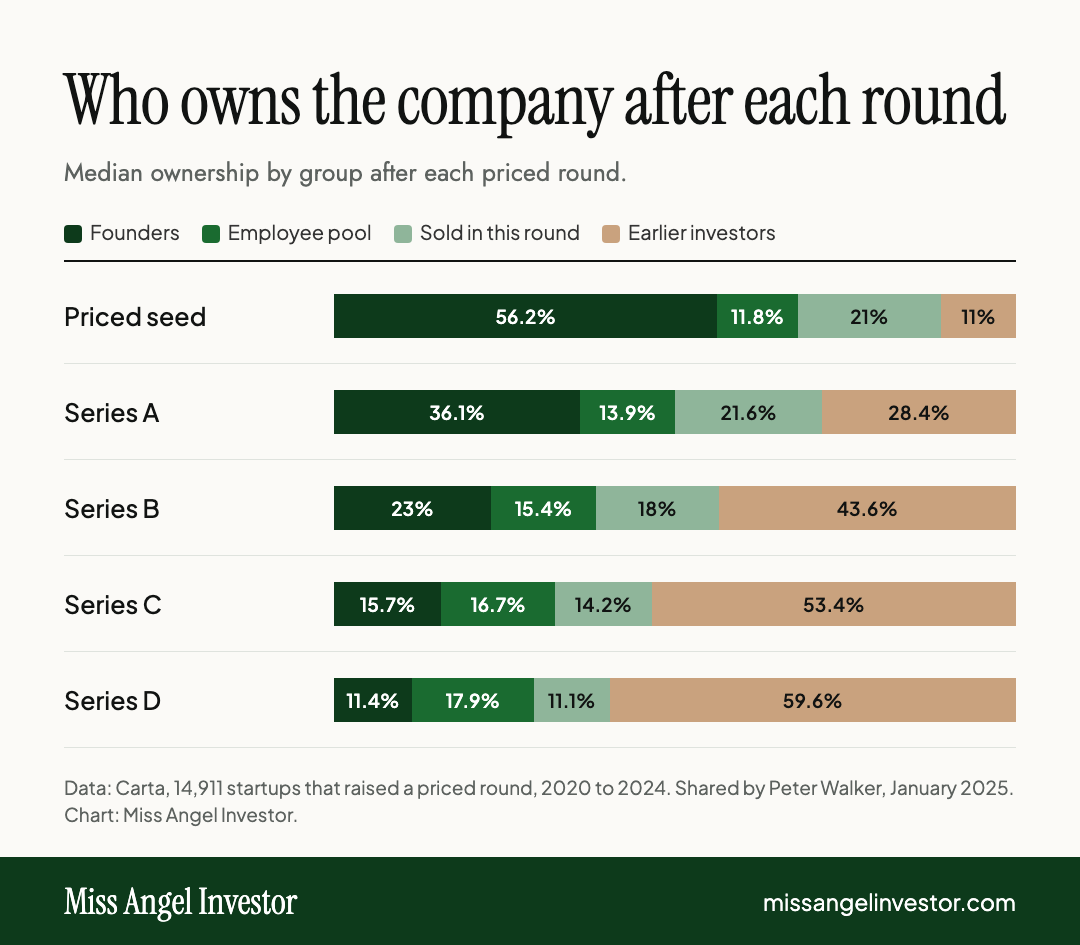
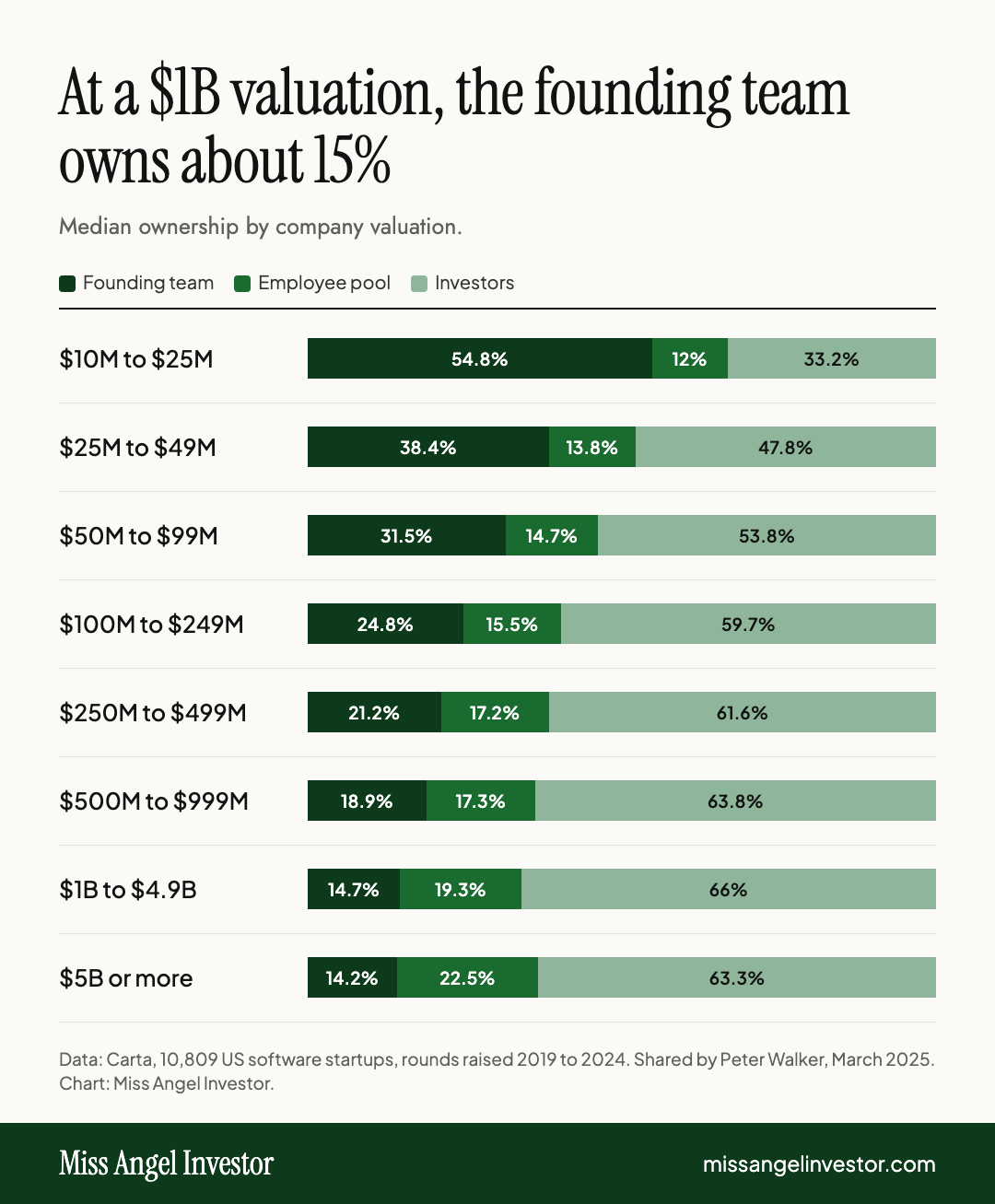
By the time a software startup is valued at $1B or more, the median founding team owns about 15%, in Carta data on 10,809 startups.
II. Financial metrics
The metrics VCs evaluate to decide whether to invest.
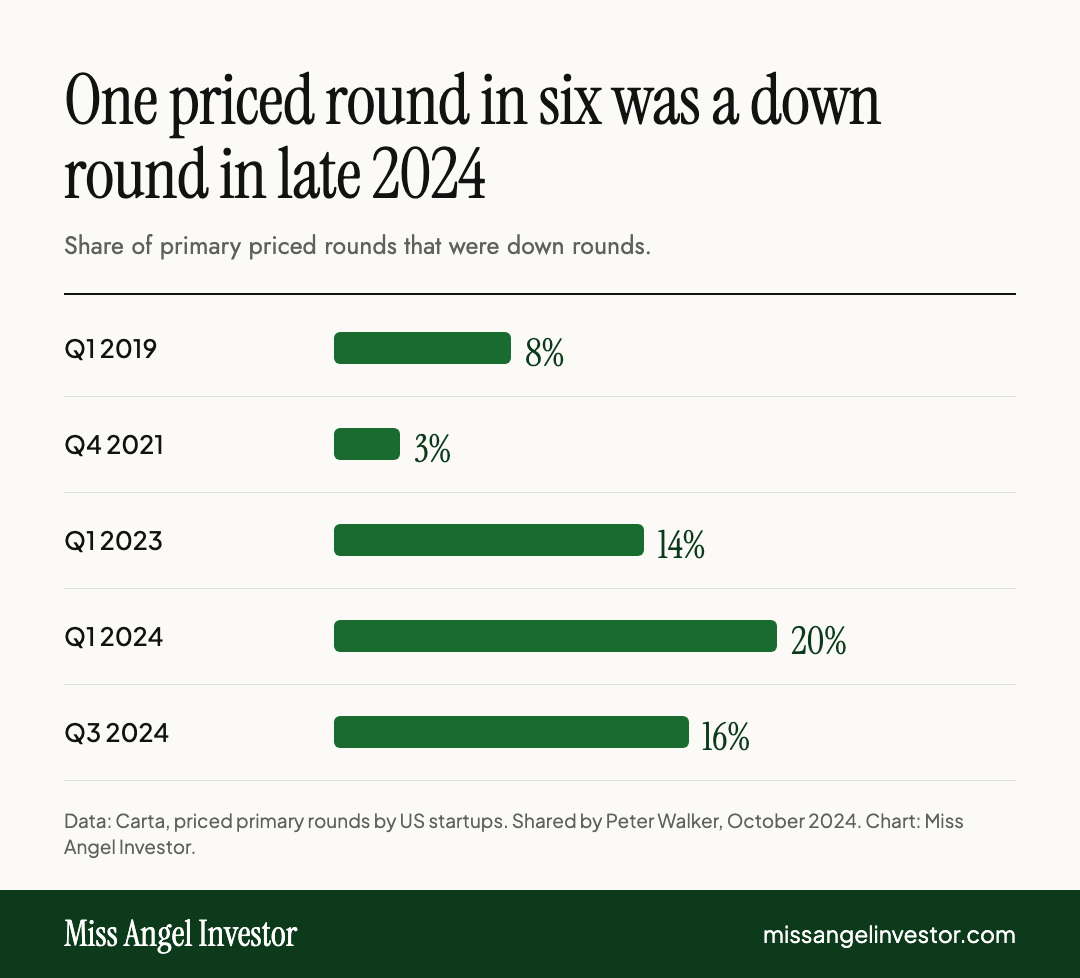
Down rounds are common. In Q3 2024, 16% of primary priced rounds on Carta were down rounds, after 20% in Q1 2024, in Carta data.
III. The fundraising process
How a raise works, stage by stage.
IV. Market and strategy
How investors judge the size of the opportunity and whether you can win it.
V. The investment ecosystem
Who gives money, and the ways to fund a company with and without them.
Resources
Tools and guides for founders:
Carta: guide to the Cayman sandwich structure for Latin American startups
Carta: complete guide to market sizing, TAM, SAM and SOM
Carta: guide to SAFEs and convertible securities
Carta: SAFE calculator, to model your SAFE conversion
Carta: term sheets, what to negotiate
No term matches that yet. Try another word, or browse the guides.